Last Updated on September 18, 2026
DLI Calculator: PPFD, Hours and Daily Light Integral
Daily Light Integral (DLI) in mol per square meter per day equals PPFD in µmol per square meter per second, times hours of light, times 0.0036. A light reading 400 PPFD run for 16 hours delivers 400 x 16 x 0.0036, or 23.04 mol per square meter per day. The table below gives sourced DLI targets for vegetable seedlings, greens and fruiting crops, and the calculator further down solves the formula either direction: PPFD and hours to DLI, or a target DLI to the PPFD or hours you need.
Target DLI for vegetable seedlings and greens
Every figure here comes from Purdue University’s Vegetable Crops Hotline, which grouped commercial vegetable transplants by the daily light integral that produces good quality seedlings. Purdue notes that ambient outdoor DLI in spring ranges from 5 to 25 mol per square meter per day across most of the United States, which is one reason seedlings started indoors under weak light often turn out thin and leggy.
| Crop | Target DLI (mol/m²/day) |
|---|---|
| Lettuce | 10 to 15 |
| Cabbage | 10 to 15 |
| Cucumber | 10 to 15 |
| Squash | 10 to 15 |
| Eggplant | 15 to 20 |
| Pepper | 15 to 20 |
| Tomato | 15 to 20 |
Purdue’s overall guidance for vegetable transplants is 10 to 15 mol per square meter per day, with fruiting crops such as tomatoes, peppers and eggplant running higher because producing fruit takes more energy than growing leaves alone. Culinary herbs are often grown at a higher DLI than lettuce, but the herb studies are inconsistent enough between trials that there is no single settled extension figure to put in this table, so herbs are left out rather than guessed at. For any of these crops, spacing, timing and frost tolerance for your zip code come from the seed starting calendar and the Plan My Garden planner further down this page, not from a light target.
The math behind DLI
PPFD (photosynthetic photon flux density) counts photons landing on a square meter of leaf surface every second, measured in micromoles. To turn that rate into a full day’s total, multiply by 3,600 to convert seconds to hours, multiply again by however many hours the light actually runs, then divide by 1,000,000 to convert micromoles into moles. That is PPFD x hours x 3,600, divided by 1,000,000, which reduces to PPFD x hours x 0.0036.
Virginia Cooperative Extension uses the same shortcut in its own worked example: a light producing 200 PPFD run for 16 hours a day comes out to 200 x 16 x 0.0036, or 11.52 mol per square meter per day. Their conclusion for that number matches the table above: strong enough for seedlings and bedding plants, but not enough for most fruiting crops, which is why tomatoes and peppers need either a brighter light or more hours than lettuce does.
DLI calculator
Pick what you want to find, fill in the two numbers you already have, and it does the arithmetic above for you. It starts on Virginia Cooperative Extension’s own example, 200 PPFD for 16 hours.
11.52 mol/m²/day
From 200 µmol/m²/s (PPFD) running 16 hours a day.
Light is one half of starting seeds indoors; the other half is timing. Plan My Garden builds a planting schedule of start indoors, transplant and direct sow dates from your zip code frost dates.
What PPFD means and how to get a number
PPFD measures the light actually landing on the plant, not the electricity a fixture draws. Virginia Cooperative Extension says it is not recommended to judge plant light with candela, lumens, foot-candles, lux, watts or joules, because those units describe human vision or electrical power rather than the photosynthetic light a leaf receives. Two lights that draw the same wattage can put out very different PPFD depending on their LEDs and design. Tim’s own grow light reviews show this: his Spider Farmer SF-1000 draws only 100 watts, while his Mars Hydro TS1000 draws 150 watts and covers a larger space. Wattage tells you what the light costs to run, not what a plant under it is receiving.
To get an actual PPFD figure, Virginia Cooperative Extension points to a few options. A dedicated quantum sensor, sometimes called a PAR meter, gives the steadiest reading and typically costs 100 dollars or more. Some LED grow lights ship with a manufacturer’s PPFD or PAR chart measured at a stated distance below the light, which is a reasonable stand in if you hang your light at that same height. The cheapest option is a phone app that reads the phone’s own camera photodiode; treat those readings as rough, useful for comparing before and after you raise or lower a light, but not precise enough to bank a seedling’s health on.
Grow light shelf versus a windowsill for seed starting
A shelf under lights beats a windowsill because a window rarely delivers enough PPFD for the hours seedlings need. Utah State University Extension says most seedlings require more light than a sunny window can provide, and recommends a fluorescent or LED plant light stand kept 2 to 4 inches above the seedlings and run 12 to 14 hours a day, with the lights off at night so plants get their needed rest. Put your own light’s PPFD into the calculator above with 12 to 14 hours and see where you land against the 10 to 15 mol range most vegetable transplants want.
If you are building that setup, How to Start Seeds Indoors covers trays, mix and timing, and Soil Blocks is Tim’s alternative to plastic cell trays. For when to start, the seed starting calendar and planning a garden layout and schedule count backward from your last frost date rather than a fixed calendar day. For the light itself, Tim has unboxed the Mars Hydro SP3000, reviewed the Mars Hydro TS1000, which he also lists on Amazon, and the Spider Farmer SF-1000, three LED options sized for a single shelf or small grow tent rather than a full greenhouse.
Quick questions
What is a good DLI for seedlings under grow lights?
Purdue University’s Vegetable Crops Hotline lists 10 to 15 mol per square meter per day as the optimal daily light integral for most vegetable transplants, with fruiting crops like tomatoes and peppers running higher at 15 to 20. Use the table above for your crop, then the calculator to find the hours or PPFD that gets you there.
Is a windowsill bright enough to start seeds?
Usually not. Utah State University Extension says most seedlings need more light than a sunny window can provide, which is why it recommends a plant light stand run 12 to 14 hours a day instead.
Does a higher wattage grow light mean a higher PPFD?
No. Virginia Cooperative Extension advises against using watts to judge how much light a fixture delivers to plants, since watts measure the electricity a light draws, not the photosynthetic light reaching the leaf. Two lights of the same wattage can produce very different PPFD depending on their LEDs and design.
How accurate are phone apps for measuring PPFD?
Rough, but useful as a starting point. Virginia Cooperative Extension says phone apps that use the camera’s photodiode are typically the cheapest way to estimate PPFD, while dedicated quantum sensors cost 100 dollars or more and give steadier readings.
How many hours a day should I run a grow light for seed starting?
Enough hours to reach your target DLI at your light’s PPFD. Utah State University Extension runs seedling lights 12 to 14 hours a day; enter your light’s PPFD into the calculator above with a 12 to 15 mol target to see if that is enough, or how many hours your setup actually needs.
Let the planner handle the calendar
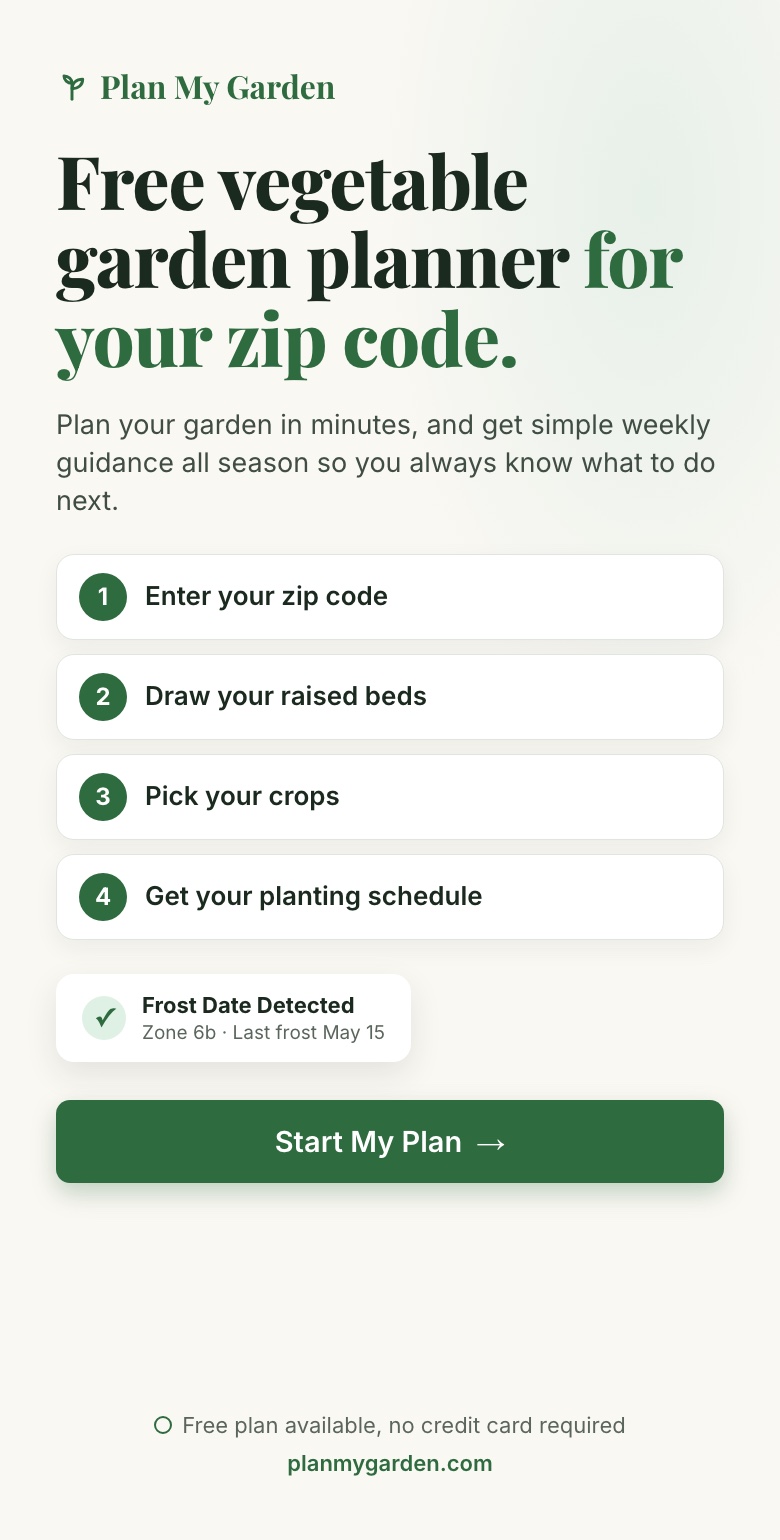
Once your seedlings are getting the right light, Plan My Garden is free to start: enter your zip code and it finds your frost dates, draw your beds, pick what you are growing, and it places each plant at square-foot spacing and builds a planting schedule from those dates.
Related: Vegetable Seed Germination Temperature Chart · Square Foot Gardening Chart · Square Foot Garden Calculator · How to Plan a Vegetable Garden Layout and Schedule