Last Updated on September 18, 2026
Square Foot Gardening Chart – Spacing Guide By Vegetable
Print it: this chart as a one-page PDF · spacing quick reference for 17 crops (PDF)
Why Use a Square Foot Garden Layout?
The square foot gardening layout is a popular method of organizing a vegetable garden because it allows you to maximize the space you have available. By dividing your garden into small, one-foot squares and carefully planning which plants go in each square, you can fit a larger number of plants into a smaller area by following guidelines in the square foot gardening chart below. This is especially useful if you have limited space for a garden, such as a small backyard or a balcony or just looking to maximize yields.
Using a square foot gardening layout also helps you to plant and grow different vegetables together in a way that maximizes their growth and productivity. By following the recommended plant spacing guidelines in the square foot gardening chart below, you can ensure that your plants have enough room to grow and thrive without overcrowding each other.
Overall, the square foot gardening layout is a great way to efficiently and effectively use your gardening space to grow a variety of vegetables. So, it is a highly recommended method for those who want to grow a large amount of food in a small area.
While our square foot gardening layout provides a detailed chart for various vegetables, it’s important to highlight that each of the vegetables listed is among the best vegetables for square foot gardening. This guide will delve deeper into why these specific vegetables are perfect for maximizing your gardening efficiency and space.
First, start building a square foot garden template
First, divide your garden into 1-foot squares. This can be done by drawing lines in the soil with a rake or using strings are guides. In the example below we divided up the 4′ X 8′ raised bed, into 32 garden squares with string. This produces a square foot garden template to begin working with. This creates a grid that allows you to easily plan and plant your garden, ensuring that each square foot is used efficiently. Finally, After building the template, you can then decide which vegetables or plants you want to grow in each square and plant by making a placement plan according to the square foot gardening chart below. Square foot gardening is a great way to maximize the space in your garden and ensure that you are growing a diverse and abundant harvest.
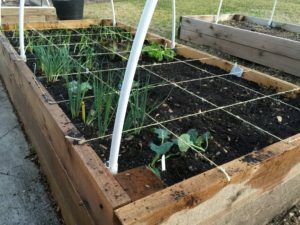
Next, plants are sown or transplanted into each 1×1 square in multiples of 1, 2, 4, 9, or 16 depending on the crop.
See the square foot planting placement example below.
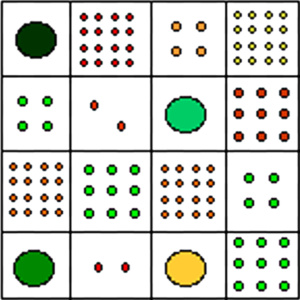
Last, there are some vegetables that take up a lot of space like pumpkins for example. Those will require at least 4 squares for 1 plant and should be trained outside of the growing area. Tomatoes on the other hand could be pruned and grown vertically as close as 1 square foot, however allowing for 1 per every 4 squares is best. I have added those details in the square foot gardening chart below.
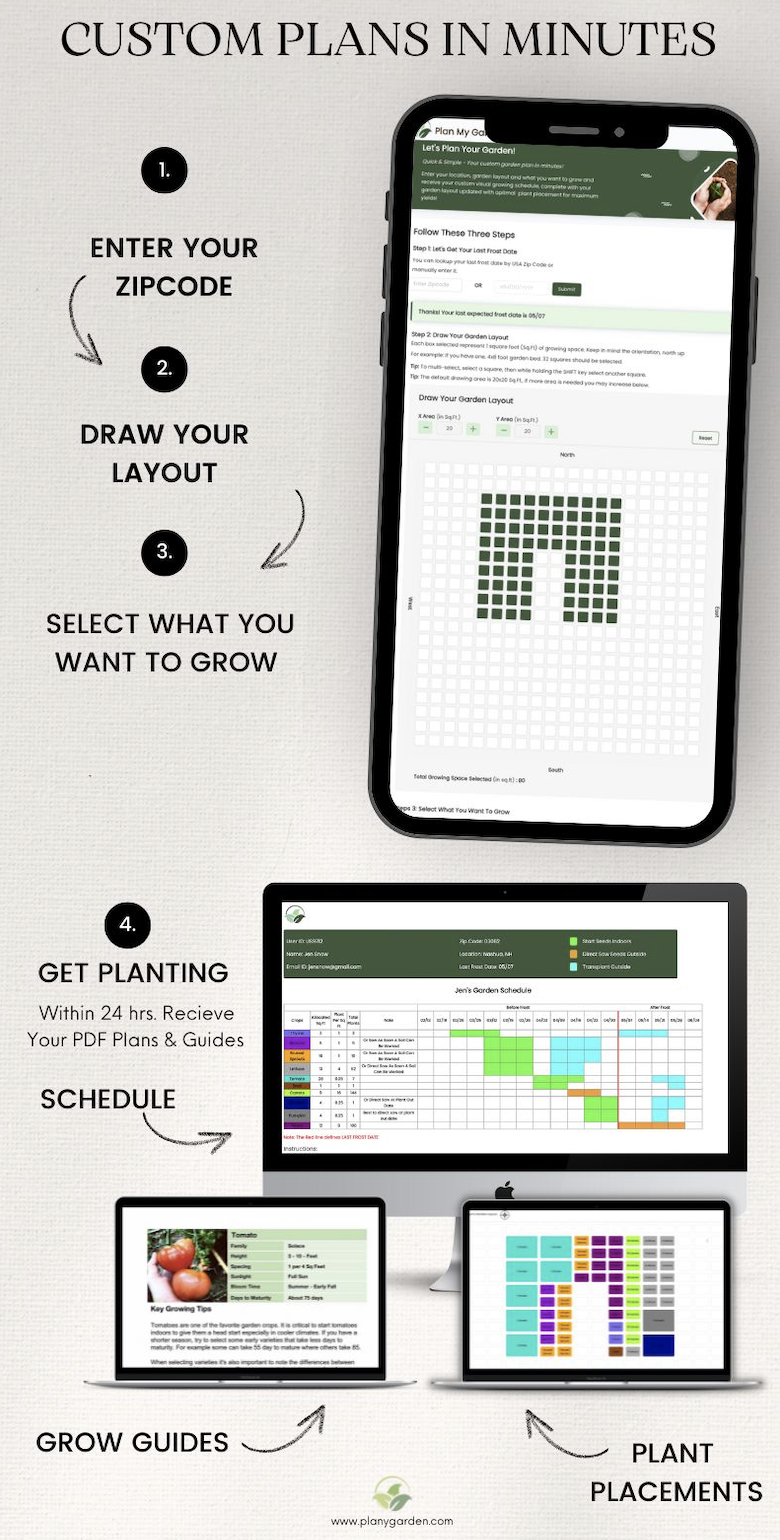
Need help planning your square foot garden? Try Plan My Garden Square foot gardening planner now! With our easy-to-use online planner, you can create a custom garden plan in just minutes. Simply enter your zip code, draw your desired layout, and select the vegetables you want to grow and how much.
The moment you finish, you get a visual planting schedule and your plant layout with spacing for your square foot garden. Free to start; Pro adds grow guides for each vegetable and PDF export.
Don’t wait any longer to start your gardening journey – get your personalized square foot garden plan today with Plan My Garden!
Square Foot Gardening Chart By Vegetable
Below is a square-foot garden layout chart of popular plants and their optimal planting spacing. Use this square foot gardening chart as a plant spacing guide for your square foot garden.
| Vegetable Type | Spacing Per Square | Vegetable Type | Spacing Per Square |
|---|---|---|---|
| Artichoke | 1 per 4 squares | Oregano | 1 |
| Arugula | 4 | Parsley | 4 |
| Asian Greens | 4 | Parsnips | 9 |
| Basil | 2-4 | Peanuts | 1 |
| Beans (bush) | 9 | Peas | 9 |
| Beets | 9 | Peppers (Bell) | 1 |
| Bok Choy (baby) | 9 | Peppers (All Others) | 1 |
| Broccoli | 1 | Potatoes | 2 |
| Broccoli Rabe | 1 | Pumpkins | 1 per 4 squares |
| Brussel Sprout | 1 | Quinoa | 4 |
| Cabbage | 1 | Radicchio | 2 |
| Cantaloupe | 1 per 4 squares | Radishes | 16 |
| Carrots | 16 | Rhubarb | 1 |
| Cauliflower | 1 | Rosemary | 1 |
| Celery | 4 | Rutabagas | 4 |
| Celtuce | 2 | Sage | 1 |
| Chives | 4 | Scallions | 16 |
| Cilantro | 1-9 | Shallots | 4 |
| Collards | 1 | Sorrel | 2 |
| Corn | 4 | Spinach | 9 |
| Cucumbers | 2 | Squash | 1 per 4 squares |
| Dill | 2 | Strawberry | 1-4 |
| Eggplant | 1 | Swiss Chard | 4 |
| Endive | 4 | Tarragon | 1 |
| Fennel | 4 | Tomatoes | 1 per 4 squares |
| French Sorrel | 4-9 | Turnips | 9 |
| Garlic | 4 | Thyme | 4 |
| Green Onions | 16 | Wasabi | 1 |
| Kale | 1 | Watercress | 1 |
| Kohlrabi | 4 | Watermelon | 1 per 4 squares |
| Leeks | 9 | Yams | 4 |
| Lettuce (leaf) | 4 | Zucchini | 1 per 4 squares |
| Lettuce (head) | 4 | Blueberries | NA (See Below) |
| Melons | 1 per 4 squares | Raspberries | NA (See Below) |
| Mint | 1-4 | ||
| Onions (bunching) | 16 | ||
| Onions Large | 4 |
Per-crop spacing guides
Each of these takes one crop from the chart and adds the planting pattern, how many fit a 4×4 and 4×8 bed, germination temperatures and where I get the seed.
- How many onions per square foot? 4 per square
- How many green onions and scallions per square foot? 16 per square
- How many zucchini per square foot? 1 per 4 squares, or 1 per square staked
- How many cucumbers per square foot? 2 per square on a trellis
- How many peppers per square foot? 1 per square
- How many lettuce per square foot? 4 per square
- How many carrots per square foot? 16 per square
- How many tomatoes per square foot? 1 per square pruned, 1 per 4 unpruned
- How many beans per square foot? 9 bush, 8 pole
- How many peas per square foot? 8 to 9 on a trellis
- How many beets per square foot? 9
- How many spinach per square foot? 9
- How many kale per square foot? 1
- How many garlic per square foot? 4 cloves
- How many potatoes per square foot? 2, or 1 for big tubers
- How many broccoli per square foot? 1
- How many strawberries per square foot? 1
- How many artichoke plants per square foot? 1 per 4 squares
- How many arugula plants per square foot? 4 per square
- How many basil plants per square foot? 1 per square
- How many bok choy plants per square foot? 4 per square
- How many Brussels sprouts plants per square foot? 1 per square
- How many butternut squash plants per square foot? 1 per 4 squares
- How many cabbage plants per square foot? 1 per square
- How many cantaloupe plants per square foot? 1 per 4 squares
- How many cauliflower plants per square foot? 1 per square
- How many celery plants per square foot? 4 per square
- How many chive plants per square foot? 4 per square
- How many cilantro plants per square foot? 9 per square
- How many collard plants per square foot? 1 per square
- How many corn plants per square foot? 4 per square
- How many dill plants per square foot? 2 per square
- How many eggplant plants per square foot? 1 per square
- How many kohlrabi plants per square foot? 4 per square
- How many leeks per square foot? 9 per square
- How many okra plants per square foot? 1 per square
- How many oregano plants per square foot? 1 per square
- How many parsley plants per square foot? 4 per square
- How many pumpkin plants per square foot? 1 per 4 squares
- How many radish plants per square foot? 16 per square
- How many rosemary plants per square foot? 1 per square
- How many sage plants per square foot? 1 per square
- How many shallots per square foot? 4 sets per square
- How many squash plants per square foot? 1 per 4 squares
- How many Swiss chard plants per square foot? 4 per square
- How many thyme plants per square foot? 1 or 4 per square
- How many turnip plants per square foot? 9 per square
- How many watermelon plants per square foot? 1 per 4 squares
- Seed starting calendar by last frost date enter your frost date, get the week to start, transplant and sow every crop
Choosing the Best Vegetables for Square Foot Gardening Spacing
Each vegetable featured in our square foot gardening chart ranks among the best vegetables for square foot gardening, chosen for their ability to maximize both space and efficiency in your garden. Let’s explore why these specific vegetables excel in square foot gardening vegetable spacing.
- Artichokes, Broccoli, and Cabbage: These larger plants thrive when given their own squares, preventing overcrowding and allowing for optimal growth, making them some of the best choices for square foot gardening.
- Root Vegetables (Carrots, Radishes, Beets): Known for their below-ground growth, these vegetables are ideal for dense planting, enabling you to harvest substantial yields from a relatively small area—perfect for the spatial efficiency required in square foot gardening.
- Leafy Greens (Lettuce, Spinach, Swiss Chard): These varieties are excellent for close spacing and successive planting, ensuring a continual harvest and making them top picks for your square foot garden.
- Climbing Plants (Peas, Beans, Cucumbers): By training these plants up trellises, you effectively utilize vertical space, increasing the productivity of your garden’s footprint without expanding its area.
Blueberries and Raspberries: Spacing and Placement
While square foot gardening is a great way to maximize the yield of your vegetable garden, some plants, like blueberries and raspberries, require more space and a different approach to planting.
When it comes to blueberries, they need at least 3 feet of space between each plant to grow and produce fruit. Moreover, blueberries require acidic soil with a pH between 4.5 and 5.5, which may not be compatible with the soil in your vegetable garden. Therefore, it’s best to plant blueberries in their own separate space, either in containers or a dedicated patch in your yard.
As for raspberries, they also need about 2-3 feet of space between each plant, as they can spread and produce suckers. However, unlike blueberries, raspberries are more adaptable to different soil types and pH levels. Nonetheless, it’s still recommended to plant raspberries in their own area, preferably with a trellis or support system to help them grow vertically and avoid crowding.
In summary, while blueberries and raspberries can be a delicious addition to your garden, they require a different approach to planting and spacing compared to vegetables and other plants. Make sure to give them plenty of room to grow and expand, and consider planting them outside of your vegetable garden area for optimal results.
Planning Ahead By Creating A Garden Layout Plan
Planning your garden layout can be a daunting task, especially if you are new to gardening. However, with a little bit of planning and organization, you can easily create a beautiful and productive garden.
One important aspect to consider when designing your garden layout is the amount of space required by each plant. By using this square foot gardening chart above, you can determine the exact amount of space needed for each type of vegetable. Square foot gardening vegetable spacing helps you to maximize your garden space and ensure that all plants have enough room to grow and thrive.
Another important factor to consider is the placement of larger plants in relation to smaller ones. You want to avoid having larger plants shade out smaller ones, so it’s important to position them in such a way that allows for plenty of sunlight to reach all parts of the garden. Our Plan My Garden square foot gardening planner helps with this by suggesting the best placement for larger vegetables in the north and east sections of the beds, and placing larger plants at the edges of the beds so they can sprawl out.
By taking the time to carefully plan your garden layout, you can create a beautiful and productive garden that will provide you with a bounty of fresh vegetables all season long. And with our square foot gardening planner, Plan My Garden you can easily create your custom garden layout plan for free. Don’t wait any longer to start your gardening journey – get your personalized square foot garden plan today!”
Converting Seed Packet Plant Spacing to Square Foot Plant Spacing
To calculate the number of plants that can fit in each square foot of your garden for square foot gardening vegetable spacing, refer to the seed packet for the recommended plant spacing. This information can be found on the back of the packet and will tell you the distance between plants within a row. Simply disregard the row spacing and focus on the plant spacing.
To calculate the number of plants per square foot in your garden, use this formula:
(Planting area length / Plant spacing) * (Planting area width / Plant spacing) / Number of square feet in planting area = Total number of plants per square foot
For a simple example, of a 1 square foot planting area and the recommended plant spacing is 3 inches, the calculation would be:
(12 inches / 3 inches) * (12 inches / 3 inches) / 1 square foot = 16 plants per square foot
You can simply replace the planting area length and width with your own values, and the plant spacing with the recommended value from your seed packet.
Lastly, don’t worry, you don’t have to do the math yourself. See the quick reference below or use our seed packet square foot spacing calculator below.
If the Seed Packet Recommends Plant Spacing Of:
- 3 inches, you can fit 16 plants in each square foot.
- 4 inches, you can fit 9 plants in each square foot.
- 6 inches, you can fit 4 plants per square foot.
- 12 inches, you can fit 1 plant per square foot.
Wrapping Up: Harnessing the Power of the Square Foot Gardening Chart for Optimal Yield
In conclusion, selecting the best vegetables for square foot gardening and effectively using a square foot gardening chart are essential for maximizing your garden’s productivity. These strategies guide you in optimizing plant placement and spacing, ensuring a diverse and prolific harvest from every square inch of your garden space.
Try Plan My Garden now and receive a custom visual planting schedule, a getting started guide, grow guides for each vegetable, and a personalized plant layout. Don’t wait any longer—get your personalized square foot garden plan now and transform your gardening experience!
See How Plan My Garden – Square Foot Garden Planner Works
See how Plan My Garden works
Enter your zip code, draw your beds, pick your crops, and get a personalized planting schedule for your exact location. Free to start, no guesswork.
Bookmark This Page!
You’ll find yourself wanting to reference this chart through the growing season – don’t forget to bookmark this page! Finally, check out our handy seed germination temperature chart.
Square Foot Gardening Spacing FAQ
A: A square foot garden layout is a way of organizing a garden by dividing it into small, evenly spaced squares, each representing one square foot of space.
A: Square foot garden layouts are useful for maximizing space and maximizing yields in small garden spaces. They also make it easier to plan and organize a garden, as you can easily see how much space each plant will need.
A: To start building a square foot garden template, divide your garden into 1-foot squares using either a rake or strings as guides.
A: To use the square foot gardening layout chart by vegetable, simply look up the vegetable you want to plant and follow the recommended spacing guidelines. This will help you plan out your garden and ensure that each plant has enough space to grow.
A: To plan ahead by creating a garden layout plan, first identify all the garden space you have and map out how much space you have and where to position each vegetable. Consider the size and growth habits of each plant to ensure that larger plants don’t shade out smaller ones.
A: To easily plan your square foot garden use a square foot gardening planner like Plan My Garden. Simply enter your zip code, draw your layout, and enter the plants you want to grow. Plan My Garden gives you a visual planting schedule and a plant layout for your square foot garden in minutes.
(Planting area length / Plant spacing) * (Planting area width / Plant spacing) / Number of square feet in planting area = Total number of plants per square foot. Use our Seed Packet Square Foot Spacing Calculator to make things simple.
The number of plants you can plant in a square foot garden will depend on the type of plants you are growing and the spacing between them – you can typically place 1, 2, 4, 8, 9, or 16 plants per square foot. Use this square-foot gardening chart above for each specific vegetable.
Yes, Square foot gardening can be worth it, it is an effective way to maximize the output you can provide in a garden space and make planning much easier. It is also an easy way to keep your garden organized and make sure everything is planted in the right place.
Plan My Garden is a square foot gardening planner that helps users efficiently plan and design their garden layout. It provides visual planting schedules and a plant layout for square foot gardening, free to start. Pro is $59 a year and adds grow guides and PDF export.
Absolutely! Beginners might find it easier to start with vegetables that are less demanding and highly rewarding. Some of the best vegetables for square foot gardening beginners include lettuce, radishes, bush beans, and Swiss chard. These are not only easy to grow but also adapt well to the compact spaces of square foot gardens.
If you’re looking to maintain a year-round garden in frost-free areas, some of the best vegetables for square foot gardening include kale, carrots, and broccoli. These can be grown in different seasons and are resilient across various weather conditions.
Green Onions: Plant 16 green onions per square foot. This arrangement ensures a consistent and plentiful supply of these flavorful onions.
Onions (Bunching): Bunching onions also thrive with 16 per square foot. This density is ideal for growing clusters that are ready to harvest.
Onions (Large): For large onion varieties, plant 4 per square foot. This provides the necessary space for the bulbs to grow to full size.
When planting basil in square foot gardening, you can grow between 2 to 4 plants per square foot. Here’s what to consider:
2 Plants per Square Foot: For larger basil varieties or those requiring more airflow, aim for 2 plants per square foot. This spacing gives each plant sufficient room to grow and produce abundant foliage.
4 Plants per Square Foot: Smaller basil varieties can be spaced 4 per square foot, maximizing yield in limited space while ensuring enough room for each plant to thrive.
Adjust the spacing based on your basil variety and available garden space to achieve the best growth and harvest.
Plant 4 parsley plants per square foot. This spacing ensures ample growth room and a plentiful harvest.
Plant 2 dill plants per square foot. They grow very tall and big, so this spacing provides enough room for them to flourish.
For both lettuce head and leaf varieties, plant 4 lettuce plants per square foot. This provides sufficient space for healthy growth while maximizing your garden’s yield.
You can grow 2 cucumber plants per square foot. Don’t forget to use a trellis to maximize yields and provide sturdy support for healthy growth.
Plant 4 thyme plants per square foot. This spacing ensures ample room for each plant while optimizing the use of your garden space.
Plant 1 broccoli plant per square foot, even for smaller varieties like broccolini. This spacing provides ample room for growth and helps maximize yields.
Supplies: organic seed, code PMG5 (Wood Prairie) · spacing quick reference (printable PDF). Affiliate links; buying through them supports this site at no cost to you.
Related guides: Seed germination temperature chart · Raised bed soil calculator · How to build a raised garden bed · Raised bed layout ideas · Charts and Tools hub · 4×4 bed layout · 4×8 bed layout · 3×6 bed layout