Last Updated on September 17, 2026
How Many Dill Plants per Square Foot?
2 dill plants per square foot, set diagonally about 6 inches apart, is what my square foot gardening chart and the Plan My Garden planner use. That number moves once you say what the dill is for: up to 4 per square for a dense leaf patch or a compact variety like Fernleaf, down to 1 per square for a tall plant you leave to flower and set seed.
The spacing pattern, by goal
| Growing goal | Per square foot | Inches apart | 4×4 bed (16 sq) | 4×8 bed (32 sq) | 3×6 bed (18 sq) |
|---|---|---|---|---|---|
| All-purpose (chart and planner default) | 2 | about 6 in, set diagonally | up to 32 | up to 64 | up to 36 |
| Dense, for a cut leaf patch | 4 | 6 in, standard grid | up to 64 | up to 128 | up to 72 |
| Compact varieties (Fernleaf and similar dwarf types) | 4 | 6 in, standard grid | up to 64 | up to 128 | up to 72 |
| Sparse, for a tall plant left to flower and seed | 1 | 12 in | up to 16 | up to 32 | up to 18 |
Those bed totals are grid maximums, not a plan. Full-size dill grows 2 to 5 feet tall on hollow stems that lean or blow over without support, per University of Wisconsin Extension, and it self-seeds readily if the seed heads ripen, per Wisconsin Extension and NC State Extension. Most gardeners give it one or two squares, not a whole bed.
Why sources disagree: 1, 4, or 9 per square
My square foot gardening chart already explains its own pick: dill grows very tall and big, so 2 per square gives it enough room to flourish. Unlike the chart’s usual multiples of 1, 4, 9, or 16, two per square has no ordinary grid: it means two plants set diagonally across the square, about 6 inches apart, not lined up in rows. The planner sets dill the same way.
That 6 inch diagonal sits inside a wider range once you factor in what the dill is for. University of Minnesota Extension thins full-size dill, grown for a season of leaves or a big seed head, to 10 to 12 inches apart, about 1 per square; NC State Extension gives the same low end, 12 inches. University of Wisconsin Extension thins seedlings grown for cutting to just 3 to 6 inches apart, covering the higher counts, 4 to 9 per square, that other sites give for a dense leaf patch.
So 1, 4, and 9 per square are not wrong: they are extension spacing for a full-size plant, a leaf patch, and the tighter end of that leaf spacing. My chart’s 2 per square is a middle setting for a plant grown both ways.
Planting the square
- Sow seed about 1/4 inch deep directly in the square (University of Minnesota Extension, NC State Extension); dill does not transplant well, so start it where it will grow.
- Pick a spot with six to eight hours of direct sun and some shelter from wind, since the hollow stalks lean or blow over without it (University of Minnesota Extension).
- Seeds germinate in 10 to 14 days. Thin to 10 to 12 inches apart for a full-size plant, or leave seedlings closer, 3 to 6 inches, for a dense leaf patch (University of Minnesota Extension, University of Wisconsin Extension).
- Stake a leaning plant, and cut foliage back often to delay flowering and stretch the leaf harvest (Penn State Extension).
- Deadhead spent flower heads if you do not want volunteers next spring; left alone, dill drops ripe seed and self-seeds readily (University of Wisconsin Extension, University of Illinois Extension).
When to plant dill
These are the windows the Plan My Garden planner and my seed starting calendar use, counted from your average last spring frost. Turn the weeks into dates with the seed starting calendar, or enter your zip code on Plan My Garden.
| Start indoors | n/a (the planner sows dill directly) |
|---|---|
| Transplant out | n/a |
| Direct sow | 8 weeks before to 4 weeks after your last frost |
| Days to maturity | about 55 days, per my vegetable days to maturity chart |
| Frost tolerance | Semi-hardy, per the planner and my vegetable frost tolerance chart, which lists dill as tolerant of light frost down to 28°F but killed below 24°F, citing University of Wisconsin |
Fernleaf and other compact varieties
Fernleaf, a 1992 All-America Selections winner, stays 12 to 18 inches tall, about half the height of a full-size plant, according to Penn State Extension and University of Georgia Extension, which adds that it needs no staking and is slow to go to seed. University of Wisconsin Extension and University of Illinois Extension both list it among the dwarf types bred for containers and small spaces.
A plant that short and self-supporting does not need the wider berth a tall type does, so give Fernleaf and similar dwarf dill the same dense spacing as a leaf patch, up to 4 per square, rather than 1 per square for a full-size plant left to flower.
Harvest and seed
For leaves, harvest anytime during the season until the flower clusters open. For seed, wait until the flower stalks are close to ripe and the seeds turn from green to tan, then cut the stalks and hang them upside down to dry (University of Minnesota Extension, for both).
Wood Prairie carries organic Bouquet dill seed: 100 days to full maturity, leaves ready in 50 days, good yields of both leaf and seed, and a plant that approaches 40 inches tall. A packet holds about 300 seeds and plants a 15 foot row, enough for about 150 squares at one seed per spot at the planner’s 2 per square, far more than a raised bed holds. Code PMG5 takes 5 percent off.
Quick questions
How many dill plants fit in a square foot?
2 dill plants per square foot, set diagonally about 6 inches apart, is the default on my square foot gardening chart and in the Plan My Garden planner. That number moves by goal: up to 4 per square for a dense leaf patch or a compact variety like Fernleaf, down to 1 per square for a tall plant left to flower and set seed.
How many dill plants fit in a 4×8 raised bed?
Up to 64 at the planner’s default of 2 per square, up to 128 dense for leaves or a compact variety, or as few as 32 for full-size plants left to flower for seed. Full-size dill grows 2 to 5 feet tall on hollow stems that lean without support, so most gardeners give it a square or two, not the whole bed.
Why do some sites say dill needs 1, 4, or 9 plants per square foot?
Each is describing one end of the spacing range for a different goal. University of Minnesota Extension thins full-size dill to 10 to 12 inches apart, about 1 per square; University of Wisconsin Extension thins a dense leaf patch to 3 to 6 inches, covering the higher counts other sites give. My chart’s 2 per square is a middle setting for a plant grown both ways.
Does dill need staking, and does it come back on its own?
Full-size dill can need staking, since its hollow stems lean or blow over without support (University of Minnesota Extension). Left alone it also drops ripe seed and self-seeds readily the following spring (University of Wisconsin Extension, NC State Extension); deadhead spent flowers if you would rather choose where next year’s plants go.
Let the planner place them
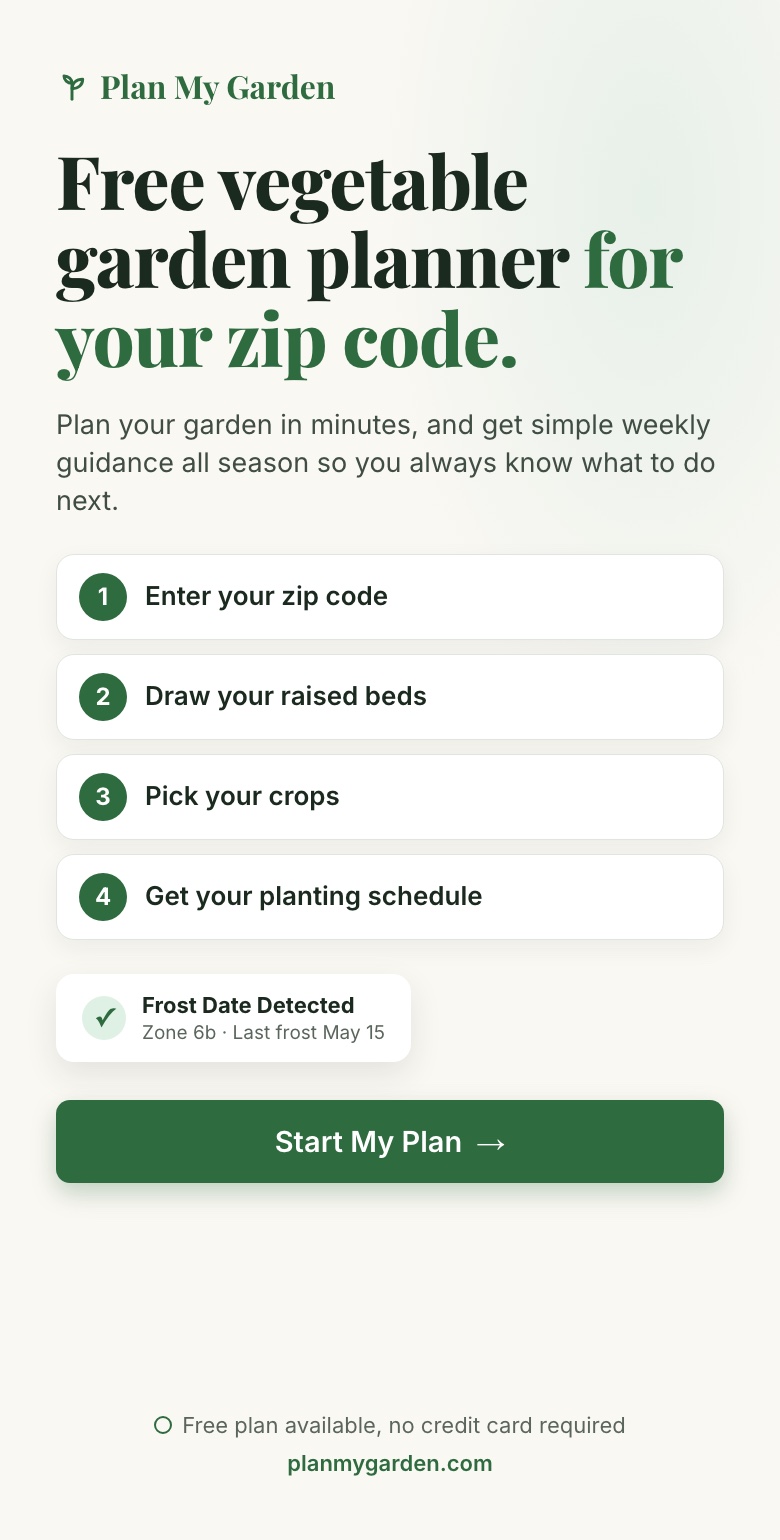
Plan My Garden is free to start: enter your zip code, draw your beds, pick dill and everything else you want to grow, and it places each plant at square-foot spacing and builds a planting schedule from your frost dates.
Related: Square Foot Gardening Chart · Seed Starting Calendar · Raised Bed Herb Garden Layout · How Many Cilantro Plants per Square Foot? · How Many Parsley Plants per Square Foot? · How Many Basil Plants per Square Foot?