Last Updated on September 17, 2026
Raised Bed Herb Garden Layout: 9 Herbs in a 4×4 Bed, With a Plan
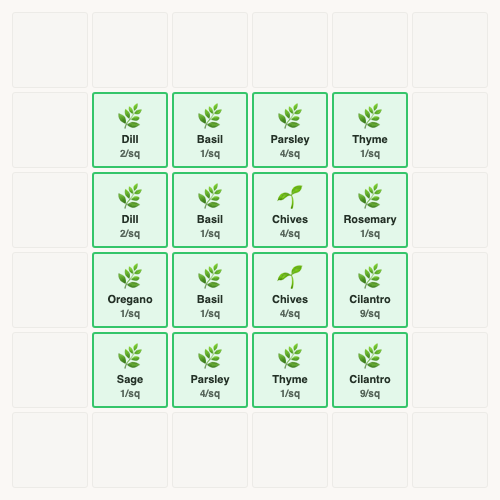
A 4×4 raised bed is 16 squares, and this herb layout fills it with nine herbs: three squares of basil, two each of dill, cilantro, parsley, chives and thyme, and one square each of oregano, sage and rosemary. That is 3 basil, 4 dill, 18 cilantro, 8 parsley, 8 chives, 2 thyme, 1 oregano, 1 sage and 1 rosemary plant, 46 plants in all.
What goes in each square
| Herb | Squares | Per square | Plants |
|---|---|---|---|
| Basil | 3 | 1 | 3 |
| Dill | 2 | 2 | 4 |
| Cilantro | 2 | 9 | 18 |
| Parsley | 2 | 4 | 8 |
| Chives | 2 | 4 | 8 |
| Thyme | 2 | 1 | 2 |
| Oregano | 1 | 1 | 1 |
| Sage | 1 | 1 | 1 |
| Rosemary | 1 | 1 | 1 |
| Total | 16 | 46 |
These are the planner’s spacings. My square foot gardening chart allows more basil (2 to 4 per square) and more thyme (4 per square), and gives cilantro a range of 1 to 9. The planner plants 1 basil and 1 thyme per square and 9 cilantro, the top of the chart’s range.
The layout square by square
Here is the same plan as a grid you can copy onto your own bed, with plants per square. Perennials are in bold.
| North edge (west on the left) | |||
|---|---|---|---|
| Dill, 2 | Basil, 1 | Parsley, 4 | Thyme, 1 |
| Dill, 2 | Basil, 1 | Chives, 4 | Rosemary, 1 |
| Oregano, 1 | Basil, 1 | Chives, 4 | Cilantro, 9 |
| Sage, 1 | Parsley, 4 | Thyme, 1 | Cilantro, 9 |
| South edge | |||
Why the herbs sit where they do
The layout runs from tall to short. Dill is the tallest herb in the planner’s crop data at 24 inches, and it holds the two northern squares of the west column, where its shade falls on the path and not on the shorter herbs. Oregano and sage, both 18 inches, fill the rest of that column. The 12 inch herbs fill the middle and east side: basil in a line of three down the second column, chives as a pair in the third, and parsley, thyme and rosemary in the squares around them. Cilantro, the shortest at 10 inches, sits as a pair in the southeast corner.
Parsley and thyme each end up with two squares that do not touch, one on the north edge and one on the south edge. In a bed this size that is no problem: every square in a 4×4 bed is on an edge or one square in from it, so no herb is more than one square in from the side.
None of these herbs climbs, so there is no trellis row and all 16 squares are planted.
Perennial and annual herbs in one bed
Seven of the 16 squares hold herbs that come back. Plan My Garden’s crop data lists chives, thyme, oregano and sage as perennials, and rosemary as a tender perennial north of zone 8. University of Maryland Extension says the same thing another way: rosemary overwinters only occasionally, depending on how hard the winter is, and a container-grown plant can be brought indoors for the winter instead, though it takes some care to keep it happy inside.
The other nine squares get replanted each year. Parsley is a biennial, and Penn State Extension lists basil, dill and coriander (cilantro) as annuals.
In this layout the perennial squares are spread across the bed. Penn State Extension notes that some gardeners keep annual and perennial herbs apart so the annual areas are easier to replant each spring, and that it is not necessary. If you want them apart, swap oregano and sage with the north parsley square and the upper cilantro square. All seven perennial squares then sit in the east half, and the only other herb there is one square of cilantro.
Why there is no mint
Mint is left out on purpose. Plan My Garden’s crop data marks mint as an aggressive spreader and says to pot it. Penn State Extension gives the standard fix for that: plant it in a 3 to 5 gallon pot with drainage holes, then sink the pot into the bed with the rim sticking up an inch or so above the soil, and prune back any creeping stems before they root in the squares next to it.
Picking them so they keep producing
These notes come from Tim’s own posts where he has one, and from extension guides for the rest.
| Herb | How to pick it |
|---|---|
| Basil | Cut the whole stem just above a pair of leaves so it keeps branching instead of flowering, which turns it woody and bitter, the method Illinois Extension gives on Tim’s basil per square foot page. Basil is frost-tender, so finish picking before your first fall frost. |
| Dill | Harvest leaves as needed and before flower buds appear. Harvest seed heads once they have turned brown (Washington State University Extension). |
| Cilantro | Cut the outer leaves regularly once the plant is 4 to 6 inches tall. Once it bolts and flowers, wait for the seed heads to turn brown and harvest them as coriander, per Utah State University Extension on Tim’s cilantro per square foot page. |
| Parsley | Harvest the older leaves as needed (Washington State University Extension). |
| Chives | Hardy enough to cut for use most of the year; the leaves and the flowers are both edible (Washington State University Extension). |
| Thyme | Pick sprigs as needed, and pinch off flower buds as they form to keep new leaves coming (Penn State Extension). |
| Oregano | Pick leaves as needed, and pinch off flower buds as they form to keep new leaves coming (Penn State Extension). |
| Sage | Trim it back in spring for bushier, fuller growth, and pick leaves as needed (Washington State University Extension). |
| Rosemary | Where winters are too cold for it outdoors, bring the potted plant inside before a hard frost, keep it somewhere cool with strong light, water only when the potting mix feels dry, and set it back outside once frost danger passes in spring (University of Maryland Extension). |
When to plant them, counted from your last frost
These are the windows the Plan My Garden planner uses for every herb in this bed, in weeks from your average last spring frost. Put your date into the seed starting calendar to turn them into dates, or look up your frost dates by zip code.
| Herb | Start indoors | Transplant out | Direct sow | Days to maturity |
|---|---|---|---|---|
| Basil | 5 to 4 weeks before | 3 weeks after | n/a | 60 |
| Dill | n/a | n/a | 8 weeks before to 4 weeks after | 55 |
| Cilantro | n/a | n/a | 4 to 1 weeks before | 50 |
| Parsley | 10 to 8 weeks before | 1 to 2 weeks after | Or as soon as the soil can be worked | 70 |
| Chives | 12 to 10 weeks before | 1 to 2 weeks after | Or at the transplant date | 90 |
| Thyme | 10 to 8 weeks before | 1 to 2 weeks after | n/a | 90 |
| Oregano | 10 to 8 weeks before | 1 to 2 weeks after | Or as soon as the soil can be worked | 80 |
| Sage | 8 to 6 weeks before | 1 to 2 weeks after | n/a | 75 |
| Rosemary | 12 to 10 weeks before | 1 to 2 weeks after | n/a | 80 |
Basil is the only herb here the planner rates tender, and it goes out last. It rates dill, cilantro, parsley and rosemary semi-hardy, and chives, thyme, oregano and sage hardy. Cilantro bolts quickly in summer heat; Tim’s cilantro per square foot page cites Oregon State University Extension on sowing it again in late summer, once the days shorten and cool off, for a second harvest.
Chives and rosemary need the longest head start, 12 to 10 weeks indoors, and parsley, thyme and oregano need 10 to 8. If that is more seed starting than you want, Penn State Extension notes that many beginners choose starter plants and set them out after the danger of frost has passed.
Where to get the seed
Wood Prairie Family Farm, a certified organic seed farm in Maine, carries organic seed for all nine herbs in this bed, including Genovese basil, Bouquet dill, Santo cilantro and Greek oregano. Code PMG5 takes 5 percent off. Buying through that link supports this site at no cost to you.
Quick questions
How many herbs fit in a 4×4 raised bed?
This layout fits nine herbs and 46 plants in 16 squares: 3 basil, 4 dill, 18 cilantro, 8 parsley, 8 chives, 2 thyme, 1 oregano, 1 sage and 1 rosemary. At the planner’s spacing a square holds 1 basil, thyme, oregano, sage or rosemary, 2 dill, 4 parsley or chives, or 9 cilantro.
Should perennial and annual herbs share a raised bed?
They can. Penn State Extension says keeping them apart is not necessary, though some gardeners do it so the annual areas are easier to replant each spring. In this bed chives, thyme, oregano and sage are perennials, rosemary comes back where winters allow, parsley is a biennial, and basil, dill and cilantro are annuals.
Can you plant mint in a raised herb bed?
Not loose in the soil. Plan My Garden’s crop data marks mint as an aggressive spreader and says to pot it: Penn State Extension’s fix is a 3 to 5 gallon pot with drainage holes, sunk into the bed with the rim sticking up an inch or so above the soil.
Where do tall herbs go in a raised bed?
On the north side, so their shade falls on the path and not on the shorter herbs. In this layout dill, the tallest herb in the planner’s data at 24 inches, holds the north end of the west column, and cilantro, the shortest at 10 inches, sits in the southeast corner.
When do you plant a raised bed herb garden?
Count from your last spring frost. In the planner’s schedule dill and cilantro can be direct sown before it, most transplants go out 1 to 2 weeks after it, and basil goes out last, 3 weeks after.
Build this bed in the planner
Build this herb bed, or one your own size, in Plan My Garden. It is free to start: enter your zip code, draw your bed, pick your herbs, and it places each plant at square-foot spacing and builds a planting schedule (start indoors, transplant and direct sow dates) from your zip code’s frost dates.