Last Updated on September 18, 2026
How Many Thyme Plants per Square Foot?
It depends on what you want the square to do. My square foot gardening chart puts 4 thyme plants per square foot, 6 inches apart. The Plan My Garden planner instead gives thyme the whole square, 1 plant per square foot, 12 inches apart. Both are right, for different goals: 4 small starts fill a square with usable thyme fast, while 1 plant left alone spreads to fill that same square as it matures over a couple of growing seasons.
The spacing pattern
| Per square foot, my chart | 4 plants, 2 by 2 grid, 6 inches apart |
|---|---|
| Per square foot, the planner | 1 plant, whole square, 12 inches apart |
| 4×4 bed (16 squares) | up to 64 plants at chart spacing, up to 16 at planner spacing |
| 4×8 bed (32 squares) | up to 128 plants at chart spacing, up to 32 at planner spacing |
| 3×6 bed (18 squares) | up to 72 plants at chart spacing, up to 18 at planner spacing |
Check any other bed size with the square foot garden calculator. Both numbers are grid maximums, not planting targets. A square packed with 4 starts today often behaves like the planner’s 1 by year two or three, a single woody clump filling the space on its own, especially with a spreading, creeping variety.
Why the chart says 4 and the planner says 1
The two numbers plan for two different stages of the same plant. My chart uses the standard square foot method, dividing 12 inches by the spacing to get a grid: 12 divided by 6 is 2, squared is 4. The planner instead sizes the square for what thyme becomes, a woody perennial that widens with age. Iowa State University Extension notes that older thyme plants develop woody centers and need trimming in spring or replacing every few years, the kind of mature spread the planner’s single-plant square is built for. Use the chart’s 4 for a full square of usable thyme quickly, for drying or heavy cooking. Use the planner’s 1 if you’re planting for the long term and want to skip a thinning step. Either way expect to prune the plant back rather than pull it: thyme is a hardy perennial, not a reseed it every spring crop.
Creeping thyme spreads, upright thyme stays put
Not every thyme grows the same way, and that changes which spacing makes sense. Iowa State University Extension splits thyme into upright culinary types and creeping ornamental types, recommending gardeners match the growth habit to its use. Common thyme (Thymus vulgaris), the standard culinary variety, forms a compact mound about 10 to 12 inches tall and stays put. Wild thyme (Thymus serpyllum), also called creeping thyme, instead forms a low mat 3 to 6 inches tall that spreads outward as it grows. North Carolina State University Extension describes that habit for a related species, Mother of thyme (Thymus praecox): the stems spread out horizontally and take root to form a flat mat. Plant a creeping variety at the planner’s 1 per square, 12 inches apart, and expect it to crawl past the edges within a season or two. Plant common, upright thyme there instead and it holds closer to the mound Iowa State describes.
Harvesting and cutting back woody stems
Iowa State University Extension says to harvest thyme as needed throughout the growing season, and for the best flavor, cut leafy stems shortly before flowering or when the first blossoms begin to open, when the essential oils are most concentrated. Use fresh sprigs right away, or air dry small bundles in a warm, well ventilated spot, then strip the leaves and store them in an airtight container away from heat and light. Thyme also needs cutting back for the plant’s sake, not just the kitchen’s: the same source recommends pruning or shearing plants lightly after flowering to keep a compact habit and encourage new growth, since older plants develop woody centers and lose vigor. Trim those woody plants back in spring, or replace them every few years, and in hot, humid summers, cutting back can help rejuvenate a plant that has started to decline.
Winter behavior in cold zones
My vegetable frost tolerance chart lists thyme among the hardy perennials that stay in the ground over winter with no row cover needed. Iowa State University Extension backs that up in general terms: winter survival varies by species and cultivar, and in the coldest regions some gardeners grow thyme as an annual rather than count on it coming back. Prostrate, mat forming types often overwinter better than upright ones, and winter injury can still show up on woody stems after a severe winter. North Carolina State University Extension notes that creeping thyme (Thymus praecox) remains evergreen during mild winters, so a hard freeze is the exception that damages it, not the rule.
Propagation by division or cuttings
Once a thyme plant is established, you rarely need to buy more seed. Iowa State University Extension says thyme is easy to propagate from seed, stem cuttings, layering, or division, and that cuttings, layering, and division all produce plants that stay true to the parent cultivar the way seed grown plants may not. Established clumps can be divided in spring, and stem cuttings root readily under favorable conditions. North Carolina State University Extension gives a more specific timeline for creeping thyme: divide in spring or late fall, and take semi hard cuttings in mid to late summer.
When to plant thyme
These are the windows the Plan My Garden planner and my seed starting calendar use, counted from your average last spring frost. Turn the weeks into dates with the seed starting calendar, or enter your zip code on Plan My Garden to find your frost dates.
| Start indoors | 10 weeks before to 8 weeks before your last frost |
|---|---|
| Transplant out | 1 week after to 2 weeks after your last frost |
| Direct sow / divisions | No separate week in the planner. Divide established clumps in spring once frost danger has passed, matching the transplant window above, per Iowa State University Extension. |
| Days to maturity | about 90 days on my vegetable days to maturity chart, for a first harvest from seed. A division with roots already in place establishes and can be cut much sooner. |
| Frost tolerance | Hardy on my vegetable frost tolerance chart, one of the hardy perennials that overwinters in place without a cover. |
Seed
Wood Prairie carries organic English thyme, 90 days, a bushy plant 6 to 8 inches tall that works well as a perennial border planting. A packet holds about 250 seeds, enough to plant a 25 foot row, and Wood Prairie recommends starting it indoors about a month before your last spring frost: organic English thyme seed. Code PMG5 takes 5 percent off.
Quick questions
How many thyme plants fit in a 4×8 raised bed?
Up to 128 at the chart’s 4 per square, 6 inches apart, or up to 32 at the planner’s 1 per square, 12 inches apart.
Why does the square foot chart say 4 thyme plants and the planner say 1?
My square foot gardening chart packs 4 small starts into a square, 6 inches apart, to fill a bed with usable herb fast. The Plan My Garden planner instead gives thyme the whole square, 1 plant, 12 inches apart, sized for a woody perennial left to grow into that space over a couple of years.
What is the difference between creeping and upright thyme spacing?
Upright common thyme (Thymus vulgaris) forms a compact mound about 10 to 12 inches tall, per Iowa State University Extension, and stays put. Creeping thyme spreads horizontally and roots as it goes, per North Carolina State University Extension, so it needs more room than a 12 inch square if left alone.
Does thyme survive the winter?
Yes, in most climates. My vegetable frost tolerance chart lists thyme as a hardy perennial that stays in the ground over winter with no cover needed. Iowa State University Extension says survival still varies by species, and mat forming types generally overwinter better than upright ones.
How do you propagate thyme?
By division or cuttings. Iowa State University Extension says established clumps divide well in spring and stem cuttings root readily. North Carolina State University Extension adds that creeping thyme is commonly divided in spring or late fall, with semi hard cuttings taken mid to late summer.
Let the planner place them
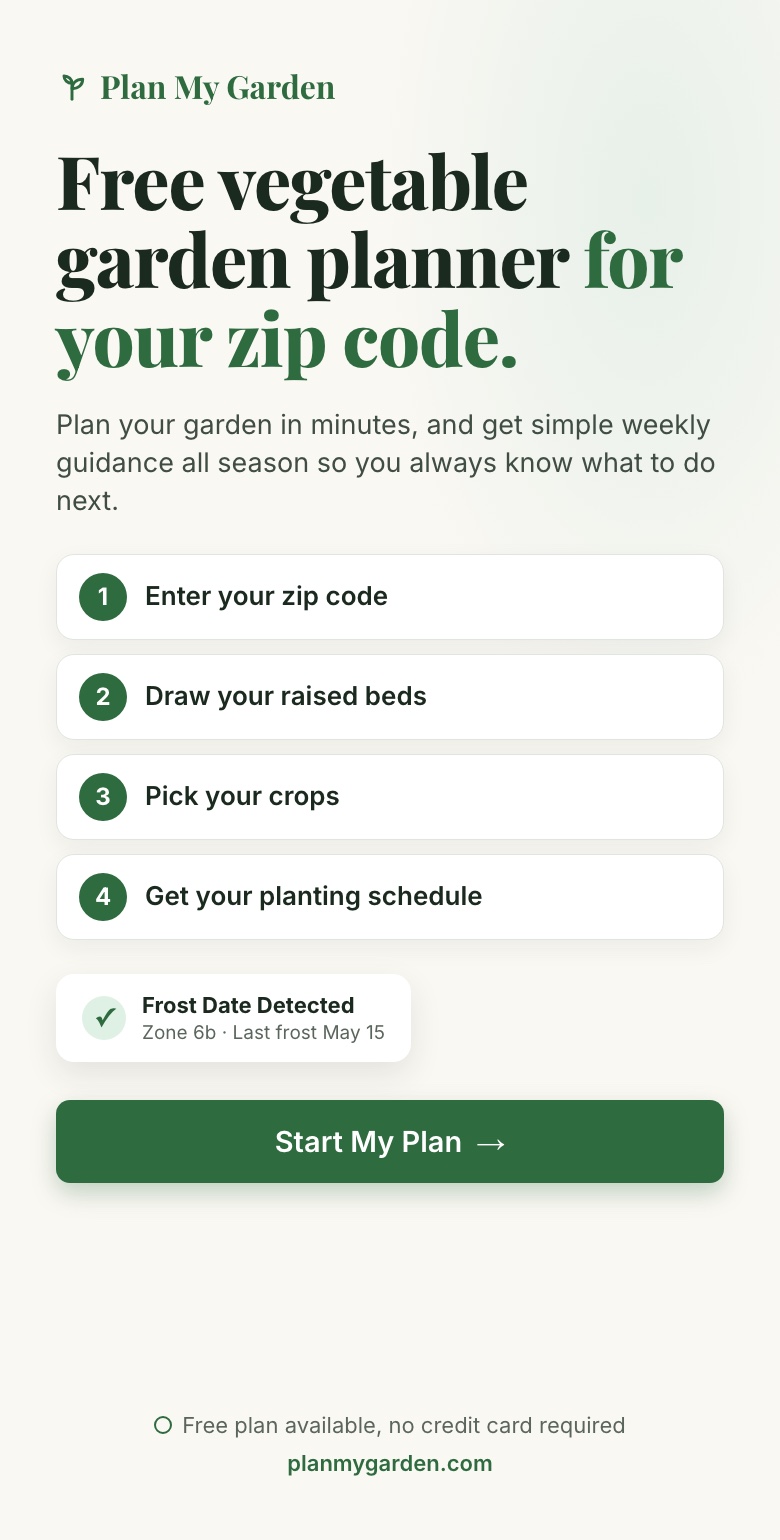
Choosing a thyme spacing is easier once the rest of the bed is planned. Plan My Garden is free to start: enter your zip code, draw your beds, pick thyme and everything else you want to grow, and it places each plant at square-foot spacing and builds a planting schedule from your frost dates.
Related: Square Foot Gardening Chart · Raised Bed Herb Garden Layout · Seed Starting Calendar · How Many Chive Plants per Square Foot? · How Many Swiss Chard Plants per Square Foot?