Last Updated on October 9, 2026
How Many Seeds per Cell? Chart by Crop
Sow one fresh seed per cell for most transplants, and two or more when the seed is older or tested low, then snip all but the strongest seedling. The exceptions are big seeds like cucumbers and squash (two or three per cell) and onions (three to five per cell, which you can plant as one clump).
University of Minnesota Extension gives the basic rule: sow fresh seeds individually, and plant two or more per cell when using older seeds with lower germination rates. The chart applies that rule crop by crop.
Seeds per cell chart
“Fresh” means seed inside its normal storage life that you expect to come up well. “Older” means past that age or a packet that sprouted 7 to 9 out of 10 in a germination test. University of Maryland Extension groups its recommended cell sizes into three bands: 3 to 6 square inches for lettuce, beets, spinach, kale and other greens; 4 to 9 for squash, cucumber, broccoli and cabbage; 9 to 16 for tomato, pepper and eggplant. Onions, scallions and the herbs below are not in Maryland’s size groups.
| Crop | Fresh seed | Older seed | Then |
|---|---|---|---|
| Tomato | 1 | 2 | Snip to 1; pot up later |
| Pepper | 1 | 2 | Snip to 1; pot up later |
| Eggplant | 1 | 2 | Snip to 1; pot up later |
| Ground cherry | 1 | 2 | Snip to 1 |
| Cucumber | 2 | 3 | Keep the strongest; no potting up |
| Squash and zucchini | 2 | 3 | Keep the strongest; no potting up |
| Melons | 2 | 3 | Keep the strongest; no potting up |
| Beans and sweet corn | 2 | 3 | Keep the strongest; no potting up |
| Broccoli and cabbage* | 1 | 2 | Snip to 1 |
| Lettuce | 1 (pelleted) | 2 | Snip to 1; cover very lightly or not at all |
| Kale, spinach and other greens* | 1 | 2 | Snip to 1 |
| Beets | 1 seed cluster | 1 seed cluster | Several seedlings come up from one “seed”; snip to 1 |
| Bulb onions | 3 | 5 | Plant the cell as a clump, or separate |
| Scallions | 6 to 8 | 8 to 10 | Plant the cell as one clump |
| Leeks | 1 | 2 | Snip to 1; one seed makes one leek |
| Basil* | 1 | 2 | Snip to 1 |
| Parsley | 1* | 2 to 3 | Snip to 1; last year’s packet counts as older |
| Cilantro* | 1 | 2 | Snip to 1; direct sowing is easier |
| Chives* | 1 | 2 | Keep 1; it grows into a clump on its own |
Sources: the singles, the two-or-three counts for big seeds, and the cell sizes above are from University of Maryland Extension; the “older seed” column is University of Minnesota Extension’s two-or-more rule (UConn’s 2 to 3 for parsley). Lettuce and ground cherry are my own counts. Onions, scallions and the herbs are explained below. The rows marked * (broccoli/cabbage, kale/spinach/other greens, basil, cilantro, chives, and parsley’s fresh-seed count) have no crop-specific source and use that general rule, not a crop-tested number.
Adjust for germination rate
The count that matters most is how well your packet sprouts. Run a germination test first: University of Illinois Extension’s method is 10 seeds on a damp paper towel, folded, placed in a plastic bag and kept warm. If all 10 grow, plant as normal. If seven to nine grow, increase the number of seeds you plant. If six or fewer grow, Illinois Extension says it is best to buy new seed. The seed viability chart shows how many years each crop’s seed usually lasts, so you know which packets to test.
A cell stays empty only if every seed in it fails, so each extra seed cuts the empty share fast.
| Seeds that sprouted in your test | 1 seed per cell | 2 seeds per cell | 3 seeds per cell |
|---|---|---|---|
| 9 of 10 | 10 empty cells in 100 | 1 in 100 | under 1 in 100 |
| 8 of 10 | 20 in 100 | 4 in 100 | under 1 in 100 |
| 7 of 10 | 30 in 100 | 9 in 100 | about 3 in 100 |
| 6 of 10 (time for new seed) | 40 in 100 | 16 in 100 | about 6 in 100 |
Arithmetic, assuming each seed sprouts at your test rate: 8 of 10 sprouting means 2 in 10 fail, and 0.2 x 0.2 = 0.04, or 4 empty cells in 100 with two seeds.
That is why one fresh seed per cell works for a packet that tests 10 out of 10, and why two per cell is the safer habit for anything older. Past three seeds the gain is small, and you spend more time snipping.
Singles: tomatoes, peppers and the big seeds
Tomatoes, peppers and eggplant need room to grow, so University of Maryland Extension says they are often started one seed per cell and moved into larger individual containers 2 to 3 weeks after germination. That is the same path I use with soil blocks: I start in 2-inch blocks and move tomatoes up into 4-inch blocks, which are made to hold the 2-inch block. My own soil block math: a 2-inch block is 4 square inches of surface and a 4-inch block is 16, in the range of Maryland’s 9 to 16 square inch tomato cells. Separately, Maryland Extension notes a 2-inch soil block is close in volume to a large cell pack.
Cucumber, squash, melons, corn and beans are different. Maryland Extension grows them only 2 to 4 weeks as transplants, with no need to pot them up, and sows two or three seeds per container or cell, keeping the strongest after germination.
Lettuce I handle one at a time: one pelleted seed in the center of each cell of an extra-deep 6-cell tray, covered lightly, about three weeks before it goes out. Maryland Extension notes lettuce seed can be left on the surface or covered very lightly.
Multi-sowing: onions and scallions
Multi-sowing means putting several seeds in one cell on purpose and planting the whole cell as one clump, with no thinning.
- Bulb onions: University of Wisconsin Extension’s onion guide, written for fresh-market growers, says to plant onion seeds 1/4 inch deep with 3 to 5 seeds per cell or soil block. Onion seed lasts only about a year in the Illinois Extension chart, so fresh seed matters here; use the high end of that range for last year’s packet. My guide to growing large onions starts the seed indoors about 10 to 12 weeks before your last frost.
- The trade-off: in a 1989 Oregon State University trial on farm-scale onion plantings, two seedlings per cell proved workable, and three per cell gave smaller bulbs but tended to raise total yield because more bulbs were harvested. That was farm research, not a backyard bed, so treat it as a direction rather than a promise: in the trial’s first planting, one seedling per cell grew the biggest bulbs, with every multi-seedling treatment reducing average bulb weight and the number of large bulbs. In the trial’s second planting that pattern did not hold. The one-seedling check had unusually low bulb weight, and some multi-seedling combinations beat it instead.
- Scallions: Oregon State’s commercial production notes say the early crop of bunching onions may be clump-seeded at 8 to 9 seeds per cell and planted out in clumps. In the same 1989 trial, sowing 6 seeds per cell gave about 5 usable stems per bunch and 10 seeds gave about 8. The chart uses 6 to 8 for fresh seed and up to 10 for older seed, inside the range Oregon State tested, for a cell you plan to transplant as one clump. If you are sowing scallions straight into the garden square instead, my green onions page uses fewer seeds, 2 or 3 per point, thinned to one.
Leeks look like a multi-sow crop but behave like a single. University of Maryland Extension notes one leek seed or transplant yields one sheath, so you need one cell for every leek you want to harvest.
Crops with a twist
- Beets: University of Wisconsin Extension explains that a beet seed is actually a cluster of seeds in a dried fruit, and several seedlings may grow from each one. One “seed” per cell is enough; snip the extras. Wisconsin also notes beets do not transplant well, so sowing them straight into the bed is the simpler route.
- Parsley: University of Minnesota Extension says parsley germination takes two to five weeks depending on seed freshness, and Illinois Extension gives parsley seed about one year of life. Treat any packet from last year as older seed and sow 2 to 3 per cell.
- Cilantro: Oregon State University Extension says cilantro grows best from direct seeding or from starts, but its long taproot makes transplanting difficult, so sowing it where it will grow is the easier route.
- Chives: Utah State University Extension notes that one chive seed produces a clump of chives within a couple of months, so you do not need a pinch of seed per cell to get a full clump.
How to thin a cell
- Wait for true leaves. That is the point University of Minnesota Extension’s thinning rule above is built on.
- Cut, do not pull. Snip the weaker seedlings off at the soil level with small scissors. Pulling or separating unwanted seedlings can damage the roots of the one you keep.
- Keep the strongest one. Each cell should end up with a single seedling, unless it is an onion or scallion clump you are planting whole. My own default with tomatoes, the same two-seed habit I use in my tomato seed starting guide, is two seeds per cell snipped to one, for insurance beyond what a single fresh seed gives you.
For the rest of the process, from mix to lights to watering, see my guide to starting seeds indoors and my soil blocks method. Seeds come up slowly in cold mix: my germination temperature chart shows tomatoes taking about 43 days to emerge in 50°F soil and about 6 days at 77°F. Maryland Extension says a potting mix temperature of 65° to 75°F is good for germinating most vegetable seeds. For when to sow, the seed starting calendar counts weeks back from your last frost, and you can look up your date on the Plan My Garden frost dates page.
Start as many cells as you will plant
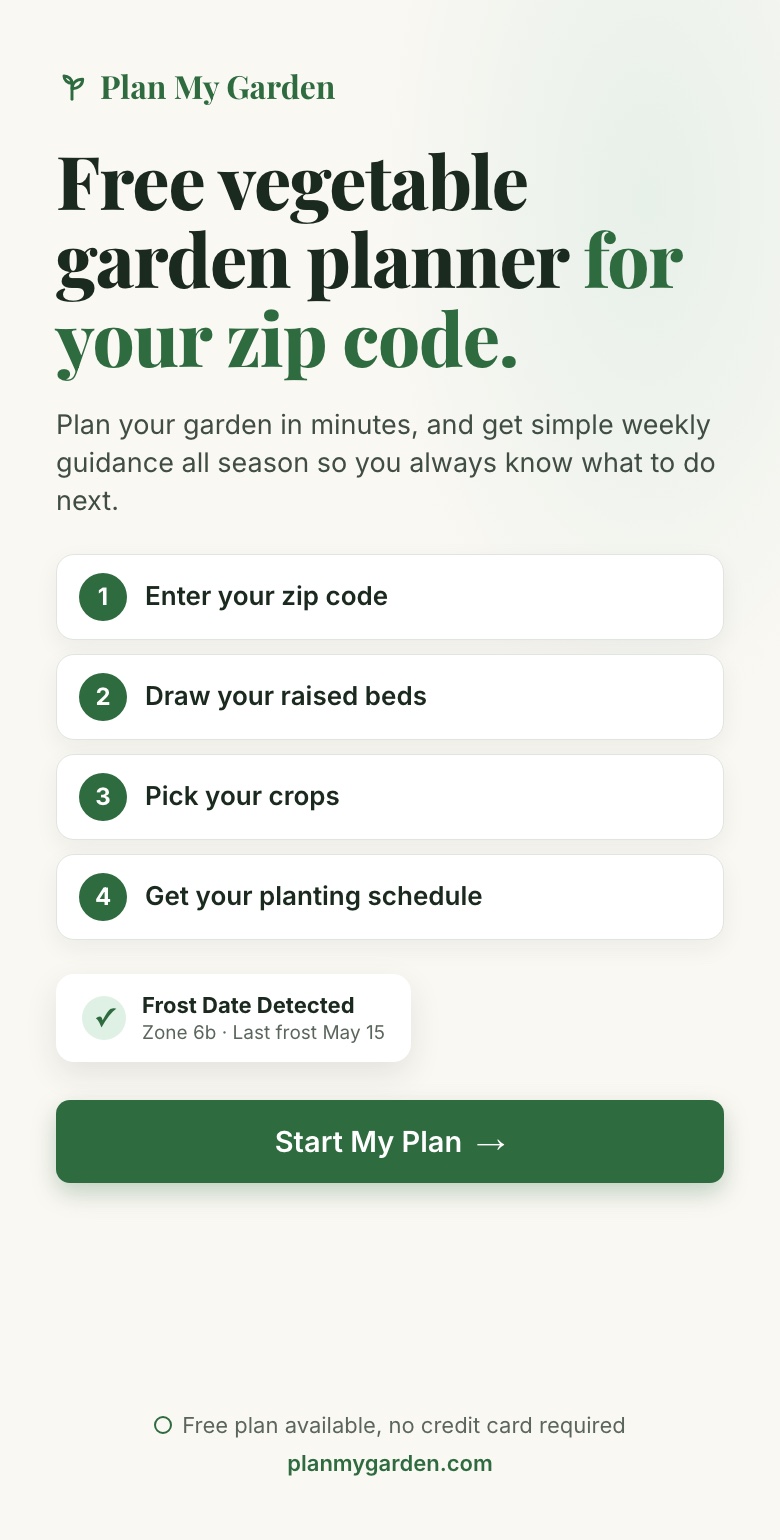
How many cells to sow depends on how many plants your beds will hold. Plan My Garden is free to start: enter your zip code, draw your beds, pick your crops, and it places each plant at square-foot spacing, so you can count the plants per bed before you fill a tray. It also builds a planting schedule from your frost dates, with start indoors, transplant and direct sow dates.
Quick questions
How many seeds should I plant per cell?
One fresh seed per cell for most transplants, and two or more when the seed is older, according to University of Minnesota Extension. Big seeds like cucumber, squash and beans get two or three, and onions three to five.
How many tomato seeds per cell?
University of Maryland Extension starts tomatoes, peppers and eggplant singly and moves them to larger containers 2 to 3 weeks after germination. With older seed, sow two and snip the weaker one. My own habit, the same two-seed start I use in my tomato seed starting guide, is two seeds per cell snipped to one, for insurance beyond Maryland’s single-seed rule.
How many onion seeds per cell?
University of Wisconsin Extension’s guide for fresh-market growers sows 3 to 5 onion seeds per cell or soil block. Plant the cell as one clump for more onions, or grow one per cell, which gave the biggest bulbs in one of two plantings in an Oregon State trial.
How many basil, lettuce or cilantro seeds per cell?
One fresh seed for each, two if the seed is older. Lettuce uses a single pelleted seed; cilantro’s long taproot makes it easier to sow straight into the garden instead of starting it in a cell.
How many extra seeds do I need for old seed?
Test 10 seeds first. University of Illinois Extension says if all 10 sprout, plant as normal; if 7 to 9 sprout, sow more; if 6 or fewer, buy new seed. At 8 of 10, two seeds per cell leave about 4 empty cells in 100 instead of 20.
Related: Seed Viability Chart · Soil Blocks for Seed Starting · How to Start Seeds Indoors · Seed Germination Temperature Chart · Seed Starting Calendar