Last Updated on October 9, 2026
How to Start Onion Seeds Indoors (and Trim the Seedlings)
Start onion seeds indoors 11 to 12 weeks before your last spring frost. Sow 1/4 inch deep, 3 to 5 seeds per cell, keep the mix near 70°F until they sprout, then grow the seedlings cool under bright light and cut the tops back to 4 inches every time they reach 5 inches. Harden them off and transplant 2 to 4 weeks before your last frost, at 4 per square foot (6 inches apart). Those windows are the ones the Plan My Garden planner uses. To turn them into dates, look up your last frost date by zip code or use my seed starting calendar.
The onion seed starting timeline
| Step | When |
|---|---|
| Sow seed indoors | 11 to 12 weeks before your last frost |
| Seedlings come up | About 4 to 5 days at 68 to 77°F soil on my chart; 6 to 12 days is normal in a tray (see below) |
| Trim the tops | Each time they reach 5 inches, back to 4 inches |
| Harden off | The 10 to 14 days before transplanting |
| Transplant out | 2 to 4 weeks before your last frost |
| Days to maturity | About 100 days |
Sowing and transplant weeks and days to maturity are from the Plan My Garden planner. Sow at 11 to 12 weeks, plant out at 2 to 4 weeks, and the seedlings spend 7 to 10 weeks indoors. That is close to Iowa State University Extension, which starts onion seed 8 to 10 weeks before planting outdoors.
Onions are the earliest seed I start every year, and the early start is the point. Iowa State explains that the amount of leaf an onion has when it starts to bulb matters: more foliage means more food available for bigger bulbs. Seedlings started indoors go out with a head start on leaves.
What you need
- Fresh seed. Onion seed lasts only about 1 year on my seed viability chart, so buy fresh seed each year.
- A cell tray or an open flat with drainage holes, plus a plastic dome or plastic wrap. Soil blocks work too.
- Seed-starting mix, moistened before you fill the tray.
- A seedling heat mat if your room is cool.
- A grow light and a timer.
- Scissors for the haircuts.
How to sow onion seeds indoors, step by step
- Moisten the mix. As in my how to start seeds indoors guide, I put the seed-starting mix in a bucket in the sink, water it lightly and stir until it is evenly moist, then fill the tray.
- Sow 1/4 inch deep, either in rows in a flat or 3 to 5 seeds per cell or soil block (University of Wisconsin Extension’s allium guide, written for market growers). You do not need one plant per cell: onions and leeks can even share one larger flat and be transplanted while still small without harm (University of Minnesota Extension).
- Label the tray with the variety and the date.
- Cover and keep warm. Put on the dome or plastic wrap and set the tray somewhere warm, around 70 to 72°F with a heat mat if your room is cool (University of Wisconsin Extension). Take the cover off as soon as they come up.
- Grow them cool and bright. Once they are up, give them bright light and moderate to cool temperatures, 55 to 65°F (Iowa State Extension), for 14 to 16 hours of light a day with the grow light about 2 to 4 inches above them (my step-by-step seed starting guide and how to start seeds indoors guide). Seedlings that flop over and look leggy are not getting enough light.
- Water from the bottom. Pour water into the tray and let the cells soak it up through the holes, so the mix stays moist without getting waterlogged.
- Trim the tops on the schedule below.
How warm the soil needs to be
From my seed germination temperature chart: onions germinate from 32°F, do best at 65 to 85°F, and stop above 95°F. These are the days to emerge at each soil temperature, from the same chart:
| Soil temperature | Days to emerge |
|---|---|
| 41°F | 30.6 |
| 50°F | 13.4 |
| 59°F | 7.1 |
| 68°F | 4.6 |
| 77°F | 3.6 |
| 86°F | 3.9 |
| 95°F | 12.5 |
Warmer is faster up to about 77°F, then it slows again. A heat mat set in the low to mid 70s keeps you close to the fast part of the curve. Expect a real tray to be slower than the chart: University of Wisconsin Extension expects onion seedlings to emerge in 6 to 12 days with the mix at 70 to 72°F, so do not worry if nothing is up by day 5.
How to trim onion seedlings: the haircut schedule
The rule is simple: when the seedlings reach 5 inches tall, clip them back to 4 inches with scissors. Do this two or more times before planting; the haircut makes for stockier, more vigorous seedlings (Iowa State Extension). I trim the tops while they grow too, so the seedlings thicken instead of flopping.
| Seedling height or stage | What to do |
|---|---|
| Under 5 inches | Leave them alone |
| 5 inches | Cut back to 4 inches |
| 5 inches again | Cut back to 4 inches again, as often as needed |
| Transplant day | Tops to 4 inches and roots to 1/2 inch |
The schedule runs on height, not on the calendar, because growth speed depends on your light and temperature. The transplant-day trim above is from University of Minnesota Extension’s onion guide; University of Wisconsin Extension’s allium guide instead clips tops to 5 inches at transplanting, to limit moisture loss while the roots re-establish. Either height works; just trim before you plant.
Long-day, short-day and intermediate onions
Onions start forming a bulb when the days reach a set length, and each variety has its own number. Pick the type before you buy seed, because the wrong one will not bulb well no matter how good your seedlings are: long-day types start bulbing at 14 to 15 hours of daylight, intermediate-day types at 12 to 13 hours, and short-day types at 10. My large onions guide has the full breakdown and variety list. Get the type wrong and a long-day onion grown under short days forms leaves but not bulbs, while a short-day onion grown under long days forms small bulbs early (University of Wisconsin Extension), so match the type to how long your summer days get and check the type in the catalog description.
Hardening off and transplanting
- Harden off first. My transplanting guide starts this about 10 to 14 days before planting out: a few hours outdoors out of direct sun at first, then more time and more sun each day.
- Size. Aim for seedlings about 1/4 inch thick at transplanting (University of Wisconsin Extension), and do not let them get much bigger: sets and transplants over 5/8 inch across bolt more easily, especially if planted too early (Utah State University Extension).
- Timing. The planner rates onions semi-hardy and puts them out 2 to 4 weeks before the last frost. Onion transplants can tolerate light frosts (University of Minnesota Extension). My frost tolerance chart has the details.
- Separate the clump. Loosen the plants when they are ready to transplant (University of Minnesota Extension) and tease the seedlings in each cell apart gently.
- Spacing. Plant 4 per square foot, a 2 x 2 grid with each onion about 6 inches from its neighbors. That fits up to 64 onions in a 4×4 bed and 128 in a 4×8. Closer spacing, at 9 or 16 per square, gives you more onions that are all smaller, which suits pearl onions but not full-size storage onions. (An older post on this site uses 9 per square foot for storage onions; this page and the current square-foot chart use 4.) The details are on how many onions per square foot.
- Depth. Set the roots and the lower white part of the plant below ground (Iowa State Extension), and water the transplants in right after planting (University of Wisconsin Extension).
Where I get onion seed
I buy organic onion seed from Wood Prairie in Maine. Each packet is about 250 seeds, enough for roughly four seeds per onion in a full 4×4 bed once you account for sowing several seeds per cell and thinning. Code PMG5 takes 5 percent off.
Quick questions
When should I start onion seeds indoors?
11 to 12 weeks before your last spring frost, the window the Plan My Garden planner uses, then transplant 2 to 4 weeks before the last frost. That gives the seedlings 7 to 10 weeks indoors.
How many onion seeds per cell?
3 to 5 seeds per cell or soil block, 1/4 inch deep, per University of Wisconsin Extension. You can also sow in rows in an open flat and tease the seedlings apart at transplanting.
How do you trim onion seedlings?
When they reach 5 inches tall, cut them back to 4 inches with scissors, and repeat each time they grow back to 5 inches. Iowa State University Extension says the haircut makes stockier, more vigorous plants.
How long do onion seeds take to germinate?
About 4 to 5 days at 68 to 77°F soil and about 13 days at 50°F, from my seed germination temperature chart. A real tray is often slower: University of Wisconsin Extension expects onion seedlings in 6 to 12 days with the mix at 70 to 72°F, so do not worry if nothing is up by day 5.
Can I start onion seeds too early?
It can backfire. Start earlier than this window and your seedlings can be oversized by transplant time. Utah State University Extension says larger transplants, over 5/8 inch across, have a greater tendency to bolt, and that transplants often bolt if planted too early. Stick to 11 to 12 weeks before your last frost.
Get your exact sowing week
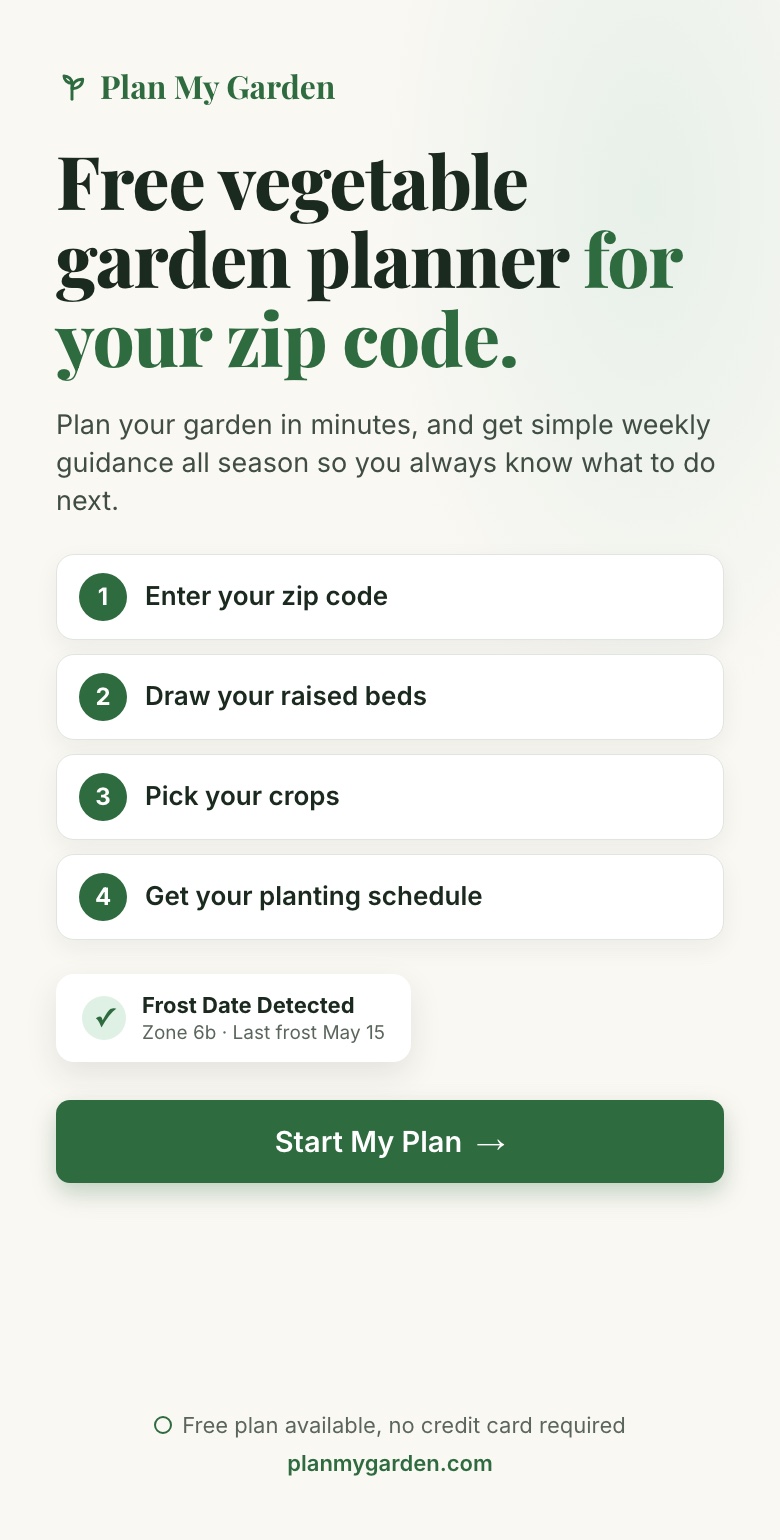
Onions are the first seeds of the year, so they are the easiest to start late. Plan My Garden is free to start: enter your zip code and it finds your frost dates, draw your beds, pick onions and everything else you want to grow, and it places each plant at square-foot spacing and builds a planting schedule (start indoors, transplant and direct sow dates) from your frost dates.
Related guides: How to start seeds indoors · How many green onions per square foot · Spring onion vs green onion · Square foot gardening chart · Charts and Tools hub