
Last Updated on September 18, 2026
4×12 Raised Bed Garden Layout: 48 Squares, 15 Crops, With a Plan
A 4×12 raised bed is 48 square feet, and this layout fills it with fifteen crops: two tomatoes and a trellis row of cucumbers and peas at the west end, then peppers, broccoli, onion, kale, beans, beets, Swiss chard, carrots, basil, radish, lettuce and spinach filling the rest. That is 2 tomato, 4 cucumber, 16 peas, 4 pepper, 2 broccoli, 16 onion, 2 kale, 36 beans, 27 beets, 2 Swiss chard, 64 carrots, 2 basil, 32 radish, 16 lettuce and 27 spinach plants, 252 in all.
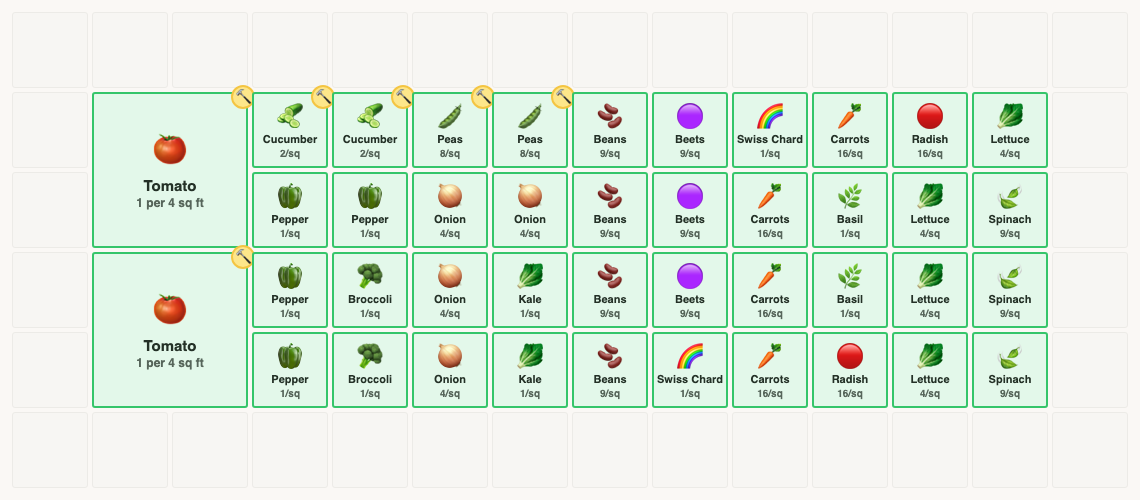
What goes in each square
Read the plan from west to east, the way the planner filled it.
| Crop | Squares | Per square | Plants |
|---|---|---|---|
| Tomato | 8 | 1 per 4 squares | 2, staked or caged |
| Cucumber | 2 | 2 | 4, on a trellis |
| Peas | 2 | 8 | 16, on a trellis |
| Pepper | 4 | 1 | 4 |
| Broccoli | 2 | 1 | 2 |
| Onion | 4 | 4 | 16 |
| Kale | 2 | 1 | 2 |
| Beans | 4 | 9 | 36 |
| Beets | 3 | 9 | 27 |
| Swiss chard | 2 | 1 | 2 |
| Carrots | 4 | 16 | 64 |
| Basil | 2 | 1 | 2 |
| Radish | 2 | 16 | 32 |
| Lettuce | 4 | 4 | 16 |
| Spinach | 3 | 9 | 27 |
| Total | 48 | 252 |
Most of these match the square foot gardening chart exactly, three need a note. Swiss chard is 1 per square here, a full-size plant 12 inches apart; my Swiss chard page explains the chart’s 4 per square is instead for the outer-leaf harvest method. Basil is 1 per square, and the chart lists 2 to 4 for smaller varieties; a full-size Genovese-type plant takes the whole square. Peas land at 8, just inside the chart’s 9; my pea page says the chart lists 9 but I plant eight to ten myself.
Why the crops sit where they do
The planner claims the northwest 2×2 blocks for tomato before anything else, so both tomato blocks stack north to south in the west two columns. Cucumbers and peas, the other trellis crops, take the north row next, right beside the tomato columns, so their shade falls on the path north of the bed rather than on the shorter crops behind them.
Everything else fills what is left, column by column moving east, tallest average height first, ties broken by whichever crop needs more squares: peppers before broccoli (both 36 inches), onions before kale (both 24), then beans, beets and Swiss chard (all about 18 inches) in that order, and carrots before basil (both 12). Swiss chard, needing only 2 squares, ends up split, picking up the one square beets left plus one more square east of it. Radish, lettuce and spinach finish the east end by height alone, shortest last so nothing shades the spinach.
The extra 4 feet, and reaching a 4×12 bed from both sides
A 4×12 bed is a 4×8 bed with one more 4-foot bay of squares, room for beets, Swiss chard, basil, radish and kale, five crops a 4×8 mix usually leaves out. Width, not length, decides reach: Iowa State University Extension puts the two-sided limit at 3 to 4 feet, and University of Minnesota Extension allows up to 5 feet. At 4 feet across, this bed is inside both, so a path on either long side reaches the full width, 2 feet in from each side. The 12-foot run just means more walking end to end; Iowa State’s path guidance of about 3 feet wide between beds, enough for a wheelbarrow, applies the same at 8 feet or 12.
When to plant them, counted from your last frost
These are the windows the Plan My Garden planner uses for every crop in this bed, in weeks from your average last spring frost. Put your date into the seed starting calendar to turn them into dates, or look up your frost dates by zip code on Plan My Garden’s frost date page.
| Crop | Start indoors | Transplant out | Direct sow | Days to maturity |
|---|---|---|---|---|
| Tomato | 5 to 3 weeks before | 2 to 3 weeks after | n/a | 80 |
| Cucumber | 3 to 1 weeks before | 2 to 3 weeks after | n/a | 60 |
| Peas | n/a | n/a | 8 weeks before to 2 weeks after | 65 |
| Pepper | 6 weeks before | 2 to 3 weeks after | n/a | 75 |
| Broccoli | 8 to 6 weeks before | 4 to 2 weeks before | n/a | 80 |
| Onion | 12 to 11 weeks before | 4 to 2 weeks before | n/a | 100 |
| Kale | 10 to 8 weeks before | 4 to 2 weeks before | n/a | 55 |
| Beans | n/a | n/a | 1 to 3 weeks after | 60 |
| Beets | n/a | n/a | 8 weeks before to 4 weeks after | 55 |
| Swiss chard | 8 to 6 weeks before | 2 weeks before | n/a | 55 |
| Carrots | n/a | n/a | 3 to 2 weeks before | 70 |
| Basil | 5 to 4 weeks before | 3 weeks after | n/a | 60 |
| Radish | n/a | n/a | 8 weeks before to 4 weeks after | 25 |
| Lettuce | 8 to 6 weeks before | 4 to 3 weeks before | n/a | 45 |
| Spinach | n/a | n/a | 8 to 1 weeks before | 40 |
The before and after split follows frost tolerance: carrots, kale and spinach are rated hardy and beets, broccoli, lettuce, onion, peas, radish and Swiss chard semi-hardy, so all ten go in before your last frost, while tender tomato, cucumber, pepper, beans and basil wait until after it.
What comes out first
Radish (25 days) is done first, ready to replace while everything else keeps growing. Spinach (40), lettuce (45) and Swiss chard and kale (55 each) are the next wave of quick greens. Onion, at 100 days, holds its squares the longest of anything in the bed.
Build this bed in Plan My Garden
Plan My Garden is free to start: enter your zip code, draw a 4×12 bed, pick your crops, and it places each plant at square-foot spacing and builds a planting schedule, with start indoors, transplant and direct sow dates, from your zip code’s frost dates.
Seed for this bed
Wood Prairie Family Farm, a certified organic seed farm in Maine, carries every crop in this bed: tomatoes, cucumbers, peas, peppers, broccoli, onions, kale, beans, beets, Swiss chard, carrots, basil, radish, lettuce and spinach. Code PMG5 takes 5 percent off. Buying through these links supports this site at no cost to you.
Quick questions
How many plants fit in a 4×12 raised bed?
With square foot spacing, 48 squares hold anywhere from 12 unpruned tomatoes to 768 carrots. This mixed layout holds 252 plants across fifteen crops, including 64 carrots, 36 beans and 32 radish.
How many tomato plants fit in a 4×12 raised bed?
Twelve if they grow unpruned, one per 2×2 block. Pruned to a single stem and grown up a string or stake, a tomato fits in one square, so up to 48. This layout uses two tomato blocks and gives the rest of the bed to fourteen other crops.
How many carrot plants fit in a 4×12 raised bed?
Up to 768 at 16 per square if the whole bed were carrots. This layout gives carrots 4 squares, 64 plants.
Which side of a 4×12 bed should the trellis go on?
The north side, so the tall crops shade the path and not the bed. This layout puts cucumbers and peas on the north row right beside the tomato block.
How wide can a raised bed be if you can reach it from both sides?
3 to 4 feet per Iowa State University Extension, up to 5 feet per University of Minnesota Extension. A 4×12 bed is 4 feet wide, so both long sides reach the full width, 2 feet in from each side.