Last Updated on September 17, 2026
2×4 Raised Bed Garden Layout: 8 Squares, 5 Crops, With a Plan
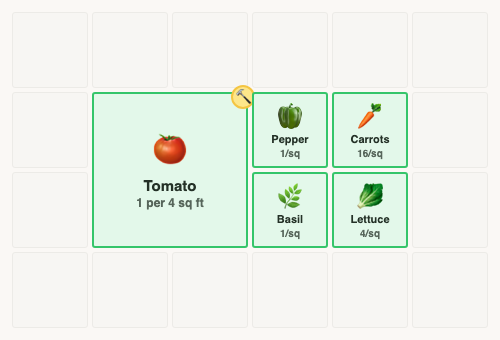
A 2×4 raised bed is 8 square feet, and this layout fills it with five crops: one tomato on a 2×2 block that takes the whole west half of the bed, then one square each of pepper, carrots, basil and lettuce. That is 1 tomato, 1 pepper, 16 carrots, 1 basil and 4 lettuce plants, 23 plants in all.
What goes in each square
| Crop | Squares | Per square | Plants |
|---|---|---|---|
| Tomato | 4 | 1 per 4 squares | 1, staked or caged |
| Pepper | 1 | 1 | 1 |
| Carrots | 1 | 16 | 16 |
| Basil | 1 | 1 | 1 |
| Lettuce | 1 | 4 | 4 |
| Total | 8 | 23 |
The counts are the planner’s spacing, and they match the square foot gardening chart for four of the five crops. Basil is the exception: the chart lists 2 to 4 basil plants per square for smaller varieties, while the planner and my own basil per square foot page put a full-size plant like Genovese at one per square, 12 inches apart, in line with what extension guides recommend. The linked crop pages show how to plant each square.
A bed 2 feet wide: reach and what fits
Two feet is the width that still works when one side of the bed is against a wall, fence or house. Iowa State University Extension says a raised bed you can reach from only one side should be no more than 1 1/2 to 2 feet wide, about arm’s reach, and a bed you can reach from both sides can be 3 to 4 feet wide. Put a 2×4 bed against a wall and the back row is still within reach. Set it out in the open and you only reach 1 foot in from each side, so nothing in the bed is a stretch. If you line up several beds, Iowa State suggests paths about 3 feet wide so a wheelbarrow or cart fits between them.
Two feet wide also means two rows of squares. Any crop the planner gives a 2×2 block, like the tomato here, fills the full width and uses half the bed. Two tomato blocks fill it completely, and that is exactly what the planner produces if you ask it for two tomatoes in a 2×4. Crops that take one square each leave room for up to four different crops in the other half, which is how this layout gets five crops into 8 squares.
Why the crops sit where they do
For this bed, the planner places the tomato first, then the rest in order of height, tallest first, filling each column from north to south and working from the west end. The tomato, which the planner’s crop data counts at 72 inches and marks as a climber, goes into the northwest-most 2×2 block it can find; in a bed 2 feet wide that is the entire west end. The pepper, next tallest at 36 inches, takes the north square of the next column, with the basil (12 inches) south of it. At the east end the carrots (12 inches) sit on the north row, and the lettuce, the shortest crop at 10 inches, takes the southeast corner.
So heights step down from west to east and from north to south. That follows the rule Clemson Cooperative Extension’s Home and Garden Information Center gives for any garden plan: put tall and trellised crops on the north side so they will not shade the shorter vegetables. Clemson also says fruiting crops like tomatoes and peppers must be grown in full sun, while crops grown for their leaves or roots can be grown in partial shade. If one end of your bed is shadier, that is the end for the lettuce and carrots.
If your bed runs north to south
A 4×2 bed is the same bed turned the other way. With the long sides running north to south and the same five crops, the planner’s placement puts the tomato block across the north end, the pepper and carrots in the middle row, and the basil and lettuce at the south end. The tomato still takes half the bed, and now that half is the north half.
How many tomatoes, peppers or cucumbers fit in a 2×4 bed
Give the whole bed to one crop and here is the most it holds, straight from the chart and the crop pages. These are grid maximums, not a recommended number, and a crop’s real spread can make the top end unrealistic in a bed this size.
| Crop | Per square | Up to, whole 2×4 bed |
|---|---|---|
| Tomato, left to bush out | 1 per 4 squares | Up to 2 |
| Tomato, pruned to a single stem | 1 | Up to 8 |
| Pepper | 1 | Up to 8 |
| Cucumber, on a trellis along the north side | 2 | Up to 8 (the 4 north squares), if the vines climb |
| Basil | 1 (planner) or 2 to 4 (chart) | Up to 8 (planner) or up to 32 (chart) |
| Lettuce | 4 | Up to 32 |
| Carrots | 16 | Up to 128 |
I prune indeterminate tomatoes to a single stem and grow them up a string or stake, which is what makes one per square work; left unpruned, a tomato is a 2×2 foot bush and gets four squares.
Cucumbers only get 2 per square because they climb. Put the trellis on the north side of the bed, and the 4 squares of the north row hold up to 8 plants while the south row stays open for shorter crops. The planner does the same: ask it for 4 squares of cucumbers in a 2×4 and it fills the north row first. A string trellis works for both tomatoes and cucumbers.
When to plant them, counted from your last frost
These are the windows the Plan My Garden planner uses for every crop in this bed, in weeks from your average last spring frost, with the frost tolerance it assigns each crop. Put your date into the seed starting calendar to turn them into dates, or look up your frost dates by zip code.
| Crop | Start indoors | Transplant out | Direct sow | Days to maturity | Frost tolerance |
|---|---|---|---|---|---|
| Tomato | 5 to 3 weeks before | 2 to 3 weeks after | n/a | 80 | Tender |
| Pepper | 6 weeks before | 2 to 3 weeks after | n/a | 75 | Tender |
| Carrots | n/a | n/a | 3 to 2 weeks before | 70 | Hardy |
| Basil | 5 to 4 weeks before | 3 weeks after | n/a | 60 | Tender |
| Lettuce | 8 to 6 weeks before | 4 to 3 weeks before | As soon as the soil can be worked | 45 | Semi-hardy |
This bed gets planted on two different days. The lettuce transplants go out 4 to 3 weeks before your last frost and the carrots are sown 3 to 2 weeks before; the planner rates lettuce semi-hardy and carrots hardy. my own lettuce page puts it plainly: lettuce goes out before the last frost because it shrugs off cold and only bolts once it gets hot. The tomato, pepper and basil are all rated tender and wait until 2 to 3 weeks after the last frost, 4 to 6 weeks after the carrots go in. In this layout the two early crops happen to share the east column, so you plant that end first and fill the rest of the bed 2 to 3 weeks after your last frost.
Harvest times are spread out too. Lettuce is the fastest crop here at 45 days to maturity. Tim harvests it by picking outer leaves, which grow back, or cutting the head at the base and letting it regrow. Basil takes 60 days, carrots 70, the pepper 75 and the tomato 80, the longest in the bed. Basil is tender and damaged by frost, so plan to finish picking it before your first fall frost; Illinois Extension’s method, cited on Tim’s basil per square foot page, is to keep cutting the stem just above a pair of leaves so it never flowers and turns bitter. For carrots, Tim sows a few squares every three weeks through summer to keep a steady harvest into fall, and says they get sweeter the longer they sit in the ground, especially after a frost.
A 2×4 salsa bed
For a small salsa bed, keep the tomato block and change the other half. Ask the planner for one tomato, two peppers, one square of onions and one of cilantro, and it puts the two peppers in the column beside the tomato, with the onions on the north square and the cilantro on the south square at the east end. The planner plants 4 onions and 9 cilantro to a square.
Tomatillos do not fit beside a tomato in a bed this size. The planner gives each tomatillo the same 2×2 block as a tomato, so two tomatillos take all 8 squares on their own.
Where to get seed
Wood Prairie Family Farm has organic seed for every crop in this bed: tomatoes, peppers such as California Wonder and Early Jalapeno, Genovese basil (listed at 68 days), lettuce such as Buttercrunch and Black Seeded Simpson, and carrots such as Little Finger and Scarlet Nantes. If a tall tomato is more than you want in a small bed, their Tiny Tim is listed as a very dwarf, 16-inch determinate cherry tomato at 60 days that needs no staking. Code PMG5 takes 5 percent off, and buying through these links supports this site at no cost to you.
Quick questions
How many plants fit in a 2×4 raised bed?
With square foot spacing, 8 squares hold anywhere from 8 large plants at one per square to 128 carrots at 16 per square. This mixed layout holds 23 plants: 1 tomato, 1 pepper, 16 carrots, 1 basil and 4 lettuce.
How many tomato plants fit in a 2×4 raised bed?
Two if you let them bush out, one per 2×2 block, which fills the bed. Pruned to a single stem and grown up a stake or string, one per square, so up to 8.
How many pepper plants fit in a 2×4 raised bed?
Up to eight at one per square foot, bell and hot peppers alike. In a mixed bed, one or two peppers next to a tomato block leaves room for greens and roots.
How many cucumber plants fit in a 2×4 raised bed?
Up to eight on a trellis along the north side: 4 squares at 2 plants per square. That leaves the south row free for shorter crops. The 2 per square only holds if the vines climb.
Can a 2×4 raised bed go against a wall or fence?
Yes. Iowa State University Extension says a bed you can reach from only one side should be no more than 1 1/2 to 2 feet wide, about arm’s reach, so a 2 foot wide bed is right at that limit.
Let the planner place them
Build this bed, or your own size, in Plan My Garden. It is free to start: enter your zip code and it finds your frost dates, draw the bed, pick your crops, and it places each plant at square-foot spacing and builds a planting schedule (start indoors, transplant and direct sow dates) from your zip code’s frost dates.