Last Updated on September 17, 2026
2×6 Raised Bed Garden Layout: 12 Squares, 8 Crops, With a Plan
A 2×6 raised bed is 12 square feet, and this layout fills it with eight crops: one tomato on a 2×2 block at the west end, then one square each of pepper, onions, beets, basil, carrots and spinach, and two squares of lettuce. That is 1 tomato, 1 pepper, 4 onions, 9 beets, 1 basil, 16 carrots, 8 lettuce and 9 spinach plants, 49 plants in all.
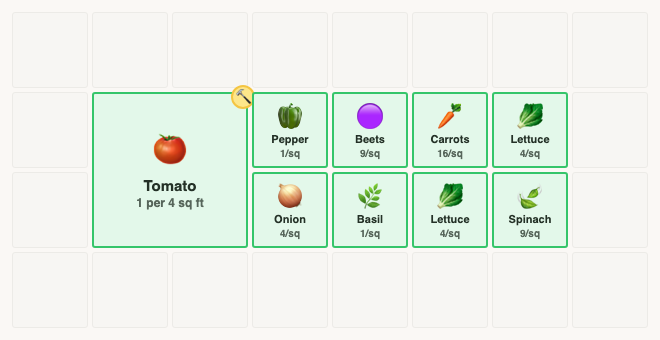
What goes in each square
Listed from the west end of the bed to the east end:
| Crop | Squares | Per square | Plants |
|---|---|---|---|
| Tomato | 4 | 1 per 4 squares | 1, staked or caged |
| Pepper | 1 | 1 | 1 |
| Onion | 1 | 4 | 4 |
| Beets | 1 | 9 | 9 |
| Basil | 1 | 1 | 1 |
| Carrots | 1 | 16 | 16 |
| Lettuce | 2 | 4 | 8 |
| Spinach | 1 | 9 | 9 |
| Total | 12 | 49 |
The plant counts are the planner’s, and for seven of the eight crops they match my square foot gardening chart. Basil is the exception. The chart lists 2 to 4 basil per square, while the planner gives one full-size basil plant a full square, which lines up with the 12 inches or more that extension guides use for basil like Genovese. The linked crop pages show the planting pattern inside each square.
Why the crops sit where they do
Here is the same plan as a grid, west end on the left, with each column one foot of the bed:
| 1st ft | 2nd ft | 3rd ft | 4th ft | 5th ft | 6th ft | |
|---|---|---|---|---|---|---|
| North row | Tomato | Tomato | Pepper | Beets | Carrots | Lettuce |
| South row | Tomato | Tomato | Onion | Basil | Lettuce | Spinach |
In a bed 2 feet wide, a tomato cannot sit behind anything. The planner gives an unpruned tomato a 2×2 block, so it fills the full width of the bed and the first 2 feet of its length: 4 of the 12 squares, a third of the bed. The planner puts that block in the north-west corner, which in a bed drawn east to west is the whole west end. The tomato is the only climber in this bed (the hammer badge), and the planner marks it “Requires support”, so set the stake or cage when you plant it.
Everything else goes in tallest first, one foot of the bed at a time from west to east, north square before south square. Using the planner’s average heights: pepper (36 inches) and onions (24) sit next to the tomato (72), beets (18) and basil (12) take the fourth foot, carrots (12) and lettuce (10) the fifth, and lettuce and spinach (6) finish the east end. The bed steps down in height from one end to the other, which is the placement rule from my square foot chart: keep larger plants from shading smaller ones.
The same order also groups the bed by planting time. The three frost-tender crops, tomato, pepper and basil, sit in the western four feet and go out 2 to 3 weeks after your last frost. The last two feet at the east end hold only carrots, lettuce and spinach, which the planner rates hardy or semi-hardy and plants before your last frost, so that end is planted and growing weeks before the west end is ready for its transplants.
Reaching a 2-foot bed from one side or both
Two feet is as wide as a bed should be when you can only get at it from one side. Iowa State University Extension says a raised bed placed against a building or fence, reachable from only one side, should be no more than 1.5 to 2 feet wide, about arm’s reach, while a bed you can reach from both sides can be 3 to 4 feet wide. A 2×6 against a wall or fence is at the top of that range: you plant, thin and pick the back row from the front.
Out in the open with a path on both long sides, every square in a 2×6 touches one of the long sides, so no square is more than a foot from the nearest path. Clemson Extension says never to walk on a raised bed once it is built, to prevent soil compaction, and in a bed this narrow you never need to. If you line up two or more 2×6 beds, Iowa State suggests paths about 3 feet wide, enough for a wheelbarrow or cart.
What fits in 2 feet of width
Any crop the planner spaces at one square fits two across. A crop that gets a 2×2 block takes the full width and uses 2 feet of the bed’s length. In the planner those are tomatoes, tomatillos, zucchini and the other squash, pumpkins and melons.
So a 2×6 holds three 2×2 blocks at most. Ask the planner for three tomatoes in this bed and it fills all 12 squares with them, one block per 2 feet, with no room left for anything else. Pruning changes the math. The way I grow indeterminate tomatoes, pruned to a single stem up a stake or string, is one plant per square foot, which would be 12 tomatoes in this bed.
When to plant them, counted from your last frost
These are the windows the Plan My Garden planner uses for every crop in this bed, in weeks from your average last spring frost, with its days to maturity and frost class. Look up your date on the Plan My Garden frost dates page, then put it into the seed starting calendar to turn these weeks into dates.
| Crop | Start indoors | Transplant out | Direct sow | Days to maturity | Frost class |
|---|---|---|---|---|---|
| Tomato | 5 to 3 weeks before | 2 to 3 weeks after | n/a | 80 | tender |
| Pepper | 6 weeks before | 2 to 3 weeks after | n/a | 75 | tender |
| Onion | 12 to 11 weeks before | 4 to 2 weeks before | n/a | 100 | semi-hardy |
| Beets | n/a | n/a | 8 weeks before to 4 weeks after | 55 | semi-hardy |
| Basil | 5 to 4 weeks before | 3 weeks after | n/a | 60 | tender |
| Carrots | n/a | n/a | 3 to 2 weeks before | 70 | hardy |
| Lettuce | 8 to 6 weeks before | 4 to 3 weeks before | n/a | 45 | semi-hardy |
| Spinach | n/a | n/a | 8 to 1 weeks before | 40 | hardy |
Which squares come free first
On the planner’s days to maturity, spinach (40 days) and lettuce (45) finish first and onions (100) finish last. Pick spinach’s outer leaves as soon as they are hand-sized and it keeps producing. Lettuce works the same way, pick outer leaves as you go, or cut the whole head at the base and let it regrow. Beets are ready at golf-ball size, seven or eight weeks after sowing, and can be left in the ground to size up further. Basil regrows from a stem cut just above a pair of leaves, and being frost-tender, it should come out before your first fall frost. Onions are done when the tops yellow and fall over, usually in late summer, and then get pulled and cured.
The planner’s fall notes add that fall lettuce avoids bolting and fall spinach does better than spring spinach, so the east-end squares that free up first are good ones to sow again for fall.
Make it your own
If your bed runs north to south, draw it that way. With the same eight crops, the planner puts the tomato block across the north end and the other seven crops in the eight squares south of it, with the taller ones down the west side.
If you do not want a tomato, its four squares hold four 1-square crops, such as two more peppers and two more basil, or one 2×2 block of zucchini. If you want only tomatoes, see above: three unpruned plants fill the bed.
Build this bed in Plan My Garden
To lay out this bed, or a bed of your own size, use Plan My Garden. It is free to start: enter your zip code, draw your bed, pick your crops, and it places each plant at square-foot spacing and builds a planting schedule (start indoors, transplant and direct sow dates) from your zip code’s frost dates.
Seed for this bed
Wood Prairie Family Farm, a certified organic seed farm in Maine, sells organic seed for all eight crops: tomatoes, peppers, onions, beets, basil among their herb seeds, carrots, lettuce and spinach. Wood Prairie’s own listings name varieties by type, including Genovese basil, Chioggia beets, and Bloomsdale Long Standing and Winter Bloomsdale spinach. Code PMG5 takes 5 percent off. Buying through these links supports this site at no cost to you.
Quick questions
How many plants fit in a 2×6 raised bed?
At square foot spacing, 12 squares hold anywhere from 3 unpruned tomato plants to 192 carrots. This mixed layout holds 49 plants across eight crops.
How many tomato plants fit in a 2×6 raised bed?
Three if you let them grow bushy, one per 2×2 block, and they fill the whole bed. Pruned to a single stem on a stake or string, it is one per square foot, so up to 12. In this mixed layout, one tomato takes the west third of the bed.
What should I plant in a 2×6 raised bed?
This layout uses one tomato, one pepper and one basil, which go out after your last frost, plus a square each of onions, beets, carrots and spinach and two squares of lettuce, which can all go in before it. That is 49 plants from 12 square feet.
Can you reach across a 2 foot wide raised bed from one side?
Yes. Iowa State University Extension puts the maximum width for a bed reachable from only one side, such as against a building or fence, at 1.5 to 2 feet, about arm’s reach. A bed you can walk around can be 3 to 4 feet wide.