Last Updated on September 18, 2026
Square Foot Garden Calculator: How Many Plants Fit in Your Bed
A square foot garden gives every square foot of bed its own square, so a 4×8 bed is 32 squares, and each crop gets a set number of plants per square: 16 carrots, 9 beets, 4 lettuce, 1 pepper, or 1 tomato per 4 squares. Enter your bed size and crops below. The calculator multiplies it out, warns you when you run out of squares, and draws a grid you can print. It also works backward: switch a crop to plants and it tells you how many squares they need.
1. Bed size
Common beds:
2. Crops Up to 12. The grid fills from the top left in this order, so list tall and climbing crops first and treat the top edge as north.
The crop picker needs JavaScript. The result below is the 4×8 example plan.
Load a plan:
4 × 8 ft bed: 32 squares. Your crops use 32, 0 free. Total: 173 plants.
| Crop | Per square | Squares | Plants |
|---|---|---|---|
| Tomatoes | 1 per 4 squares | 4 | 1 |
| Cucumbers | 2 | 1 | 2 |
| Peas | 9 | 1 | 9 |
| Peppers (bell) | 1 | 3 | 3 |
| Kale | 1 | 3 | 3 |
| Onions (large) | 4 | 2 | 8 |
| Beans (bush) | 9 | 3 | 27 |
| Beets | 9 | 3 | 27 |
| Carrots | 16 | 3 | 48 |
| Basil | 2 to 4 (counted at 2) | 3 | 6up to 12 |
| Lettuce (leaf) | 4 | 3 | 12 |
| Spinach | 9 | 3 | 27 |
| Total | 32 | 173 |
4 × 8 ft bed, 32 squares. Each square is 1 ft; put the top edge on the north side.
- Tomato Tomatoes: 1 per 4 squares, 1 plant
- Cuke Cucumbers: 2 per square, 2 plants
- Peas Peas: 9 per square, 9 plants
- PepB Peppers (bell): 1 per square, 3 plants
- Kale Kale: 1 per square, 3 plants
- Onion Onions (large): 4 per square, 8 plants
- BeanB Beans (bush): 9 per square, 27 plants
- Beet Beets: 9 per square, 27 plants
- Carrot Carrots: 16 per square, 48 plants
- Basil Basil: 2 to 4 per square, counted at 2, 6 plants
- LetL Lettuce (leaf): 4 per square, 12 plants
- Spin Spinach: 9 per square, 27 plants
Prints only the grid and its key.
How the 4×8 example adds up
The result above is the bed from my 4×8 raised bed layout, the size I build most. The tomato takes a 2×2 block, cucumbers and peas get one square each, onions get two, and peppers, kale, bush beans, beets, carrots, basil, lettuce and spinach get three each. That is 4 + 1 + 1 + 2 + (8 × 3) = 32 squares, a full bed.
Each plant count is squares times the chart: 3 squares of carrots × 16 = 48 carrots, 3 of beets × 9 = 27, 2 of onions × 4 = 8, and the tomato is 4 squares ÷ 4 = 1 plant. The whole bed comes to 173 plants. The layout page counts 8 peas and 1 basil per square, so it lists 169. The calculator uses the chart’s 9 peas and the low end of basil’s 2 to 4.
Order matters for the grid. Everything that climbs goes on the north edge, where it shades the path and not the bed; that is how the layout page places the tomato, cucumbers and peas, and UF/IFAS Extension gives the same advice for any trellis. List those crops first and they land in the top row. Two smaller plans load the same way: the 4×4 layout is 16 squares and 90 plants by the chart, and the 3×6 layout is 18 squares and 96 plants.
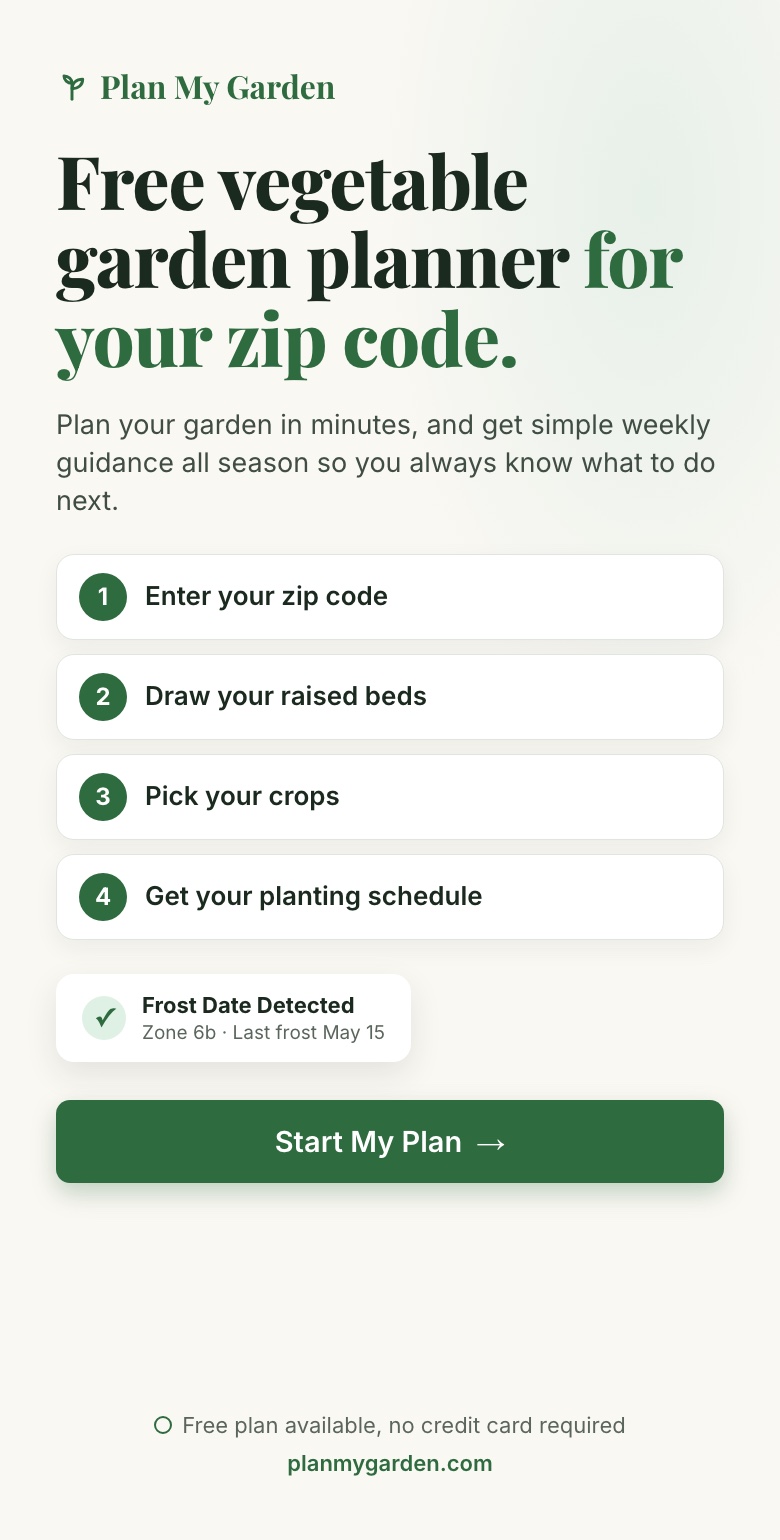
If you would rather not count squares by hand, Plan My Garden is free to start: draw your bed, pick your crops, and it places each plant at square foot spacing for you.
Plants per square for every crop on my chart
These are the numbers the calculator uses, from my square foot gardening chart, sorted A to Z. Where the chart gives a range, like basil at 2 to 4, the calculator counts the low number and shows the high one as “up to.” Three rows are not on the chart; they come from my crop pages: pole beans at 8 per square, tomatoes pruned to one stem at 1 per square, and zucchini on a stake at 1 per square. The last column is a whole 4×8 bed of one crop. It is a ceiling, not a planting plan.
| Crop | Per square | Spacing | Whole 4×8 bed, up to |
|---|---|---|---|
| Artichoke | 1 per 4 squares | 24 in (2×2 ft block) | 8 |
| Arugula | 4 | 6 in | 128 |
| Asian greens | 4 | 6 in | 128 |
| Basil | 2 to 4 | a pair, or 6 in | 64 to 128 |
| Beans (bush) | 9 | 4 in | 288 |
| Beans (pole) | 8 | around a pole or trellis | 256 on a trellis |
| Beets | 9 | 4 in | 288 |
| Bok choy (baby) | 9 | 4 in | 288 |
| Broccoli | 1 | 12 in | 32 |
| Broccoli rabe | 1 | 12 in | 32 |
| Brussels sprouts | 1 | 12 in | 32 |
| Cabbage | 1 | 12 in | 32 |
| Cantaloupe | 1 per 4 squares | 24 in (2×2 ft block) | 8, vines trained out of the bed |
| Carrots | 16 | 3 in | 512 |
| Cauliflower | 1 | 12 in | 32 |
| Celery | 4 | 6 in | 128 |
| Celtuce | 2 | a pair, about 6 in apart | 64 |
| Chives | 4 | 6 in | 128 |
| Cilantro | 1 to 9 | 12 to 4 in | 32 to 288 |
| Collards | 1 | 12 in | 32 |
| Corn | 4 | 6 in | 128 |
| Cucumbers | 2 | a pair, about 6 in apart | 64 on a trellis |
| Dill | 2 | a pair, about 6 in apart | 64 |
| Eggplant | 1 | 12 in | 32 |
| Endive | 4 | 6 in | 128 |
| Fennel | 4 | 6 in | 128 |
| French sorrel | 4 to 9 | 6 to 4 in | 128 to 288 |
| Garlic | 4 | 6 in | 128 |
| Green onions | 16 | 3 in | 512 |
| Kale | 1 | 12 in | 32 |
| Kohlrabi | 4 | 6 in | 128 |
| Leeks | 9 | 4 in | 288 |
| Lettuce (head) | 4 | 6 in | 128 |
| Lettuce (leaf) | 4 | 6 in | 128 |
| Melons | 1 per 4 squares | 24 in (2×2 ft block) | 8, vines trained out of the bed |
| Mint | 1 to 4 | 12 to 6 in | 32 to 128 |
| Onions (bunching) | 16 | 3 in | 512 |
| Onions (large) | 4 | 6 in | 128 |
| Oregano | 1 | 12 in | 32 |
| Parsley | 4 | 6 in | 128 |
| Parsnips | 9 | 4 in | 288 |
| Peanuts | 1 | 12 in | 32 |
| Peas | 9 | 4 in | 288 on a trellis |
| Peppers (all others) | 1 | 12 in | 32 |
| Peppers (bell) | 1 | 12 in | 32 |
| Potatoes | 2 | a pair, about 6 in apart | 64 |
| Pumpkins | 1 per 4 squares | 24 in (2×2 ft block) | 8, vines trained out of the bed |
| Quinoa | 4 | 6 in | 128 |
| Radicchio | 2 | a pair, about 6 in apart | 64 |
| Radishes | 16 | 3 in | 512 |
| Rhubarb | 1 | 12 in | 32 |
| Rosemary | 1 | 12 in | 32 |
| Rutabagas | 4 | 6 in | 128 |
| Sage | 1 | 12 in | 32 |
| Scallions | 16 | 3 in | 512 |
| Shallots | 4 | 6 in | 128 |
| Sorrel | 2 | a pair, about 6 in apart | 64 |
| Spinach | 9 | 4 in | 288 |
| Squash | 1 per 4 squares | 24 in (2×2 ft block) | 8, vines trained out of the bed |
| Strawberries | 1 to 4 | 12 to 6 in | 32 to 128 |
| Swiss chard | 4 | 6 in | 128 |
| Tarragon | 1 | 12 in | 32 |
| Thyme | 4 | 6 in | 128 |
| Tomatoes | 1 per 4 squares | 24 in (2×2 ft block) | 8 |
| Tomatoes (pruned to one stem) | 1 | 12 in | 32 |
| Turnips | 9 | 4 in | 288 |
| Wasabi | 1 | 12 in | 32 |
| Watercress | 1 | 12 in | 32 |
| Watermelon | 1 per 4 squares | 24 in (2×2 ft block) | 8, vines trained out of the bed |
| Yams | 4 | 6 in | 128 |
| Zucchini | 1 per 4 squares | 24 in (2×2 ft block) | 8 |
| Zucchini (staked) | 1 | 12 in | 32 |
Blueberries and raspberries are on the chart but not in the calculator. They need about 3 feet (blueberries) and 2 to 3 feet (raspberries) between plants and do best in their own patch, outside the vegetable beds.
How the square foot method counts
Square foot gardening is Mel Bartholomew’s method. The Square Foot Gardening Foundation dates it to 1976 and his first book to 1981, and the Foundation’s FAQ calls the grid the hallmark of the method. You divide the bed into 1-foot squares with string or wood strips and plant each square as its own small grid.
To turn seed packet spacing into plants per square, divide 12 inches by the spacing and multiply the answer by itself. That is the formula on my chart page:
- 3 inches apart: 12 ÷ 3 = 4 a side, and 4 × 4 = 16 per square (carrots, radishes, green onions)
- 4 inches: 3 × 3 = 9 per square (beets, bush beans, spinach)
- 6 inches: 2 × 2 = 4 per square (lettuce, garlic, large onions)
- 12 inches: 1 per square (peppers, broccoli, kale)
- 24 inches: 1 plant per 2×2 block of 4 squares (unpruned tomatoes, pumpkins, melons)
Two per square is the one count with no grid of its own. The pair goes about 6 inches apart, along the trellis edge for cucumbers. UF/IFAS Extension uses the same 1, 4, 9 and 16 counts, plus 2 per square for cucumbers on a trellis.
Seed packet spacing to plants per square
4 in apart = 9 plants per square, a 3 × 3 grid (3 a side).
The converter rounds down to whole plants a side, so a packet that says 5 inches gives 2 a side and 4 per square, each plant a little past its minimum. Spacing wider than 12 inches takes a block of squares: 18 or 24 inches is a 2×2 block, 30 or 36 inches a 3×3 block.
When the grid number is not the number to plant
- Vines. Pumpkins, melons, watermelon, cantaloupe and squash get 1 plant per 4 squares, and my chart says to train them outside the growing area. A bed full of them only works if the vines have somewhere to go.
- Tomatoes. The chart gives an unpruned tomato 4 squares. I prune to a single stem and grow them up a stake or string, which fits 1 per square. The method is in how to prune tomato plants.
- Zucchini. A bush zucchini spreads over a 2×2 block. Grown up a single stake with the lower leaves off, one fits in a square: how to grow zucchini vertically.
- Climbers. Cucumbers at 2 per square, peas at 9 and pole beans at 8 all assume something to climb. Put the trellis on the north side so it does not shade the bed.
- Strawberries. The chart allows 1 to 4. I plant 1 per square in their own bed, because runners fill every gap you give them.
- Potatoes. 2 per square gives more, smaller potatoes; 1 per square gives fewer, larger ones.
Quick questions
How many plants fit in a 4×8 square foot garden?
A 4×8 bed has 32 squares. That is up to 8 plants of a crop that takes 4 squares, like unpruned tomatoes or squash, up to 32 peppers or broccoli, and up to 512 carrots or radishes. The 12-crop example on this page holds 173 plants.
How do you calculate plants per square foot from seed packet spacing?
Divide 12 inches by the spacing on the packet and multiply the result by itself. 3 inches apart is 16 per square, 4 inches is 9, 6 inches is 4 and 12 inches is 1. A plant spaced wider than 12 inches takes a block of squares.
How many squares does a tomato plant need?
Four squares, a 2×2 foot block, if you let it grow as a bush. Pruned to a single stem and tied up a stake or string, one tomato fits in one square.
How big a square foot garden do you need per person?
Clemson Extension figures one 4×4 bed, 16 square feet, per person for fresh eating, and a second 4×4 bed, 32 square feet in all, if you also want to preserve. Planted in conventional rows, the same Clemson page puts it at about 100 square feet per crop per person.
How much soil does a square foot garden need?
The Square Foot Gardening Foundation says 6 inches of Mel's Mix grows almost any vegetable except potatoes and carrots, which need it built up deeper. A 4×8 bed filled 6 inches deep holds 4 x 8 x 0.5 = 16 cubic feet. For your own bed size, use the raised bed soil calculator on this site.
Let the planner place them
This calculator counts one bed and leaves the timing to you. Plan My Garden is free to start: enter your zip code and it finds your frost dates, draw your beds, pick your crops, and it places each plant at square-foot spacing and builds a planting schedule with start indoors, transplant and direct sow dates.
Related: Square foot gardening chart · 4×4 raised bed layout · 4×8 raised bed layout · 3×6 raised bed layout · Raised bed soil calculator · Seed starting calendar · Charts and Tools hub