Last Updated on September 18, 2026
10×10 Vegetable Garden Layout: Two 4×8 Beds, 16 Crops, With a Plan
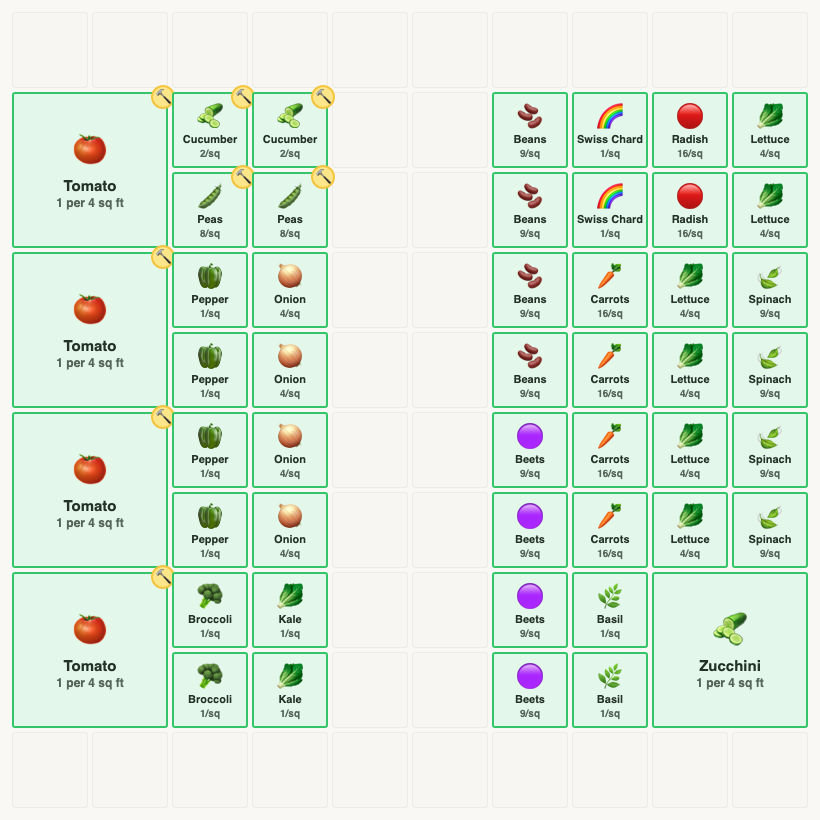
A 10×10 vegetable garden layout is 100 square feet, built here as two 4×8 raised beds with a 2 foot path down the middle: that leaves 64 square feet of actual growing space, filled with 16 crops and 281 plants placed at square foot spacing.
The plot maths: two beds, one path, 100 square feet
Two 4×8 beds side by side, each 4 feet wide, plus a 2 foot path between them, is 4 plus 2 plus 4, or 10 feet across. Each bed runs 8 feet the other way, with a 1 foot margin at the north end and another at the south end for kneeling and turning, so 8 plus 1 plus 1 is 10 feet that way too. Two beds and a path make a 10 foot square.
Of the 100 square feet in that square, only 64 are actually planted, the two 4×8 beds. The other 36 square feet is the 2 foot center path (16 square feet) plus the 1 foot margins at the north and south ends (20 square feet). That is the part most “10×10 garden layout” results skip: they draw a 100 square foot square and imply all of it grows food, when a workable layout gives more than a third of it to path and turnaround room.
The beds are 4 feet wide because that is close to the widest bed most adults can reach across from both sides without stepping on the soil. Iowa State University Extension says a bed reachable from both sides can run 3 to 4 feet wide, and a bed against a wall or fence, reachable from one side only, should top out around 1.5 to 2 feet. University of Minnesota Extension puts the two-sided limit at up to 5 feet, and the one-sided limit at 2.5 feet. Four feet sits at the top of Iowa State’s range, which is why square foot beds are built 4 feet wide far more often than wider.
What goes in each square
Sixteen crops fill the 64 squares across both beds. Each links to its own per-square-foot page for the planting pattern inside that square.
| Crop | Squares | Per square | Plants |
|---|---|---|---|
| Tomato | 16 | 1 per 4 squares | 4, staked or caged |
| Cucumber | 2 | 2 | 4, on a trellis |
| Beans | 4 | 9 | 36 |
| Swiss Chard | 2 | 1 | 2 |
| Radish | 2 | 16 | 32 |
| Lettuce | 6 | 4 | 24 |
| Peas | 2 | 8 | 16, on a trellis |
| Pepper | 4 | 1 | 4 |
| Onion | 4 | 4 | 16 |
| Carrots | 4 | 16 | 64 |
| Spinach | 4 | 9 | 36 |
| Beets | 4 | 9 | 36 |
| Broccoli | 2 | 1 | 2 |
| Kale | 2 | 1 | 2 |
| Basil | 2 | 1 | 2 |
| Zucchini | 4 | 1 per 4 squares | 1 |
| Total | 64 | 281 |
These counts are the grid’s maximums for this exact mix of crops, not a recommendation to plant every square that tight. The zucchini’s 2×2 block is a good example: it is what the layout fits into 4 squares, but a real zucchini plant spreads well past that by midsummer, so treat the block as the least space it needs rather than a snug fit. The tomato blocks work the same way, sized for an unpruned plant; a tomato pruned to a single stem on a string fits in one square instead of four.
Why the crops sit where they do
The planner claims the tomato’s 2×2 blocks first, one in the west column of each bed, before placing anything else. Cucumbers and peas, the two trellis crops here, go next, along the north row of each bed so a climbing crop never shades the shorter crops planted in front of it. Everything else fills in column by column from north to south, tallest crop first: peppers, onions and kale sit ahead of the beets, carrots, basil, lettuce and spinach that finish out each bed toward the south end. Radish and swiss chard end up next to the center path in the east bed simply because that is where a short crop landed once the taller ones claimed the north rows.
When to plant them, counted from your last frost
These are the windows the Plan My Garden planner uses for every crop in this plot, in weeks from your average last spring frost. Put your date into the seed starting calendar to turn them into dates, or look up your frost dates by zip code on Plan My Garden’s frost date page.
| Crop | Start indoors | Transplant out | Direct sow | Days to maturity |
|---|---|---|---|---|
| Tomato | 5 to 3 weeks before | 2 to 3 weeks after | n/a | 80 |
| Cucumber | 3 to 1 weeks before | 2 to 3 weeks after | n/a | 60 |
| Beans | n/a | n/a | 1 to 3 weeks after | 60 |
| Swiss Chard | 8 to 6 weeks before | 2 weeks before | n/a | 55 |
| Radish | n/a | n/a | 8 weeks before to 4 weeks after | 25 |
| Lettuce | 8 to 6 weeks before | 4 to 3 weeks before | n/a | 45 |
| Peas | n/a | n/a | 8 weeks before to 2 weeks after | 65 |
| Pepper | 6 weeks before | 2 to 3 weeks after | n/a | 75 |
| Onion | 12 to 11 weeks before | 4 to 2 weeks before | n/a | 100 |
| Carrots | n/a | n/a | 3 to 2 weeks before | 70 |
| Spinach | n/a | n/a | 8 to 1 weeks before | 40 |
| Beets | n/a | n/a | 8 weeks before to 4 weeks after | 55 |
| Broccoli | 8 to 6 weeks before | 4 to 2 weeks before | n/a | 80 |
| Kale | 10 to 8 weeks before | 4 to 2 weeks before | n/a | 55 |
| Basil | 5 to 4 weeks before | 3 weeks after | n/a | 60 |
| Zucchini | 2 to 1 weeks before | 2 to 3 weeks after | n/a | 55 |
The before and after split follows frost tolerance. The planner rates carrots, spinach and kale hardy, and swiss chard, radish, lettuce, peas, onion, beets and broccoli semi-hardy, so all ten of those go in before or straddling your last frost. Tomato, cucumber, beans, pepper, basil and zucchini are rated tender and wait until after it.
Let the planner place them
Plan My Garden is free to start: enter your zip code, draw two 4×8 beds or your own plot size, pick these crops or your own, and it places each plant at square foot spacing and builds a planting schedule, with start indoors, transplant and direct sow dates, from your zip code’s frost dates.
Quick questions
How many plants fit in a 10×10 vegetable garden?
This layout, two 4×8 beds with 16 crops at square foot spacing, holds 281 plants. Most of that count comes from small, tightly spaced crops: 64 carrots, 36 beans, 36 spinach and 36 beets alone add up to 172 of the 281.
How big is a 10×10 vegetable garden in square feet?
100 square feet total, but only 64 of those square feet are actually planted in this layout. The rest is the 2 foot path between the two beds and the 1 foot margins at the north and south ends, space you need to reach and walk the plot without stepping on the soil.
How many raised beds fit in a 10×10 garden?
Two 4×8 beds side by side, split by a 2 foot path, which is the arrangement in this layout. Each bed is 4 feet wide, close to the widest bed most people can reach across from both long sides without stepping in.
How many tomato plants fit in a 10×10 garden layout?
Up to 64 across the 64 planted squares if every tomato is pruned to a single stem and grown up a string or stake, one per square. Unpruned, a tomato needs a 2×2 block, so the ceiling drops to 16 blocks, or 16 plants. This layout uses four unpruned blocks and gives the rest of the 64 squares to 15 other crops.
How many carrots fit in a 10×10 garden layout?
Up to 1,024 across the 64 planted squares at 16 per square, if every square grew nothing but carrots. This layout gives carrots 4 squares, 64 plants, and splits the rest among 15 other crops.
Related: 4×8 Raised Bed Garden Layout · 4×4 Raised Bed Garden Layout · Square Foot Gardening Chart · Square Foot Garden Calculator · Raised Bed Soil Calculator · Raised Bed Lumber Calculator