Last Updated on October 8, 2026
How to Start Tomato Seeds Indoors
Start tomato seeds indoors 3 to 5 weeks before your last spring frost and plant them out 2 to 3 weeks after it. Sow them 1/4 inch deep in moist seed-starting mix, keep the mix at 75-85°F until they come up, then grow them under lights hung 2 to 4 inches above the leaves.
That window is the one the Plan My Garden planner uses for tomatoes. To turn it into dates, look up your last frost date by zip code or enter it on my seed starting calendar. This page is about raising the seedlings. For how many plants fit in a bed, see How Many Tomato Plants per Square Foot?
The tomato seed starting timeline
| Step | When | Basis |
|---|---|---|
| Sow indoors | 3 to 5 weeks before your last frost | Plan My Garden planner |
| Seedlings come up | About 6 to 8 days later at 65-85°F soil | My germination chart |
| Pot up | 2 to 3 weeks after they come up | University of Maryland Extension |
| Harden off | The 1 to 2 weeks before you plant out | My transplanting guide |
| Plant out | 2 to 3 weeks after your last frost | Plan My Garden planner |
Step by step
- Moisten the mix. Wet the seed-starting mix in a bucket before you fill anything. I use a mix with compost in it, like Coast of Maine.
- Pick cells or blocks. If you are just starting out, I recommend cell packs. My own tomatoes start in 2-inch soil blocks, so the roots never circle. I put two seeds in each cell.
- Sow 1/4 inch deep and keep it warm. Cover the tray with a clear dome or plastic wrap and set it on a heat mat at 75-85°F until the seedlings come up. Heat mats dry the mix out faster, so check the moisture often. Depth, temperature and the drying warning are from University of Minnesota Extension.
- Uncover and light up. Take the cover off as soon as the seeds sprout, which helps prevent damping off. Hang the lights 2 to 4 inches above the seedlings, 2 inches if you can, for 12 to 16 hours a day on a timer, with some dark each night. Do not plug the heat mat into that timer (Minnesota Extension’s seed starting guide).
- Cool them a little. Once they are up, grow them somewhat cooler: 65-70°F days and 55-60°F nights (University of Maryland Extension).
- Thin to one. Once the true leaves show, snip the weaker seedling at the soil line with scissors. Pulling it can damage the roots of the one you keep.
- Water from below. Pour water into the tray and let the cells drink it up through the holes. For soil blocks I add about an inch of water to the tray daily or every other day.
Maryland Extension says most potting mixes hold enough fertilizer to grow a seedling for at least 6 weeks, so wait before feeding. The full method for every crop is in How to Start Seeds Indoors.
How fast tomato seeds sprout by soil temperature
Soil temperature sets how fast tomato seeds come up. These are the days to emerge from my seed germination temperature chart, which uses J.F. Harrington’s UC Davis data.
| Soil temperature | Days for tomato seedlings to emerge |
|---|---|
| 41°F or colder | Little or no germination |
| 50°F | About 43 |
| 59°F | About 14 |
| 68°F | About 8 |
| 77°F | About 6 |
| 86°F | About 6 |
| 95°F | About 9 |
| 104°F | Little or no germination |
My chart puts the tomato optimum at 65-85°F, the minimum at 50°F and the maximum at 95°F. A seedling heat mat with a thermostat holds that range, which matters because potting mix indoors can run as much as 5°F cooler than the room air (Minnesota Extension).
Potting up and burying the stem
Tomatoes are the seedling you can plant deeper every time you move them, because they grow roots along any buried stem. Pot them up 2 to 3 weeks after they sprout, into a container 1 to 2 inches wider than the cell. Set each one so only the leaves and growing tip sit above the mix. Hold it by a leaf, never the stem: a seedling can grow a new leaf, but one that loses its main growing point may not survive. The timing and depth are Maryland Extension’s, the pot size and handling Minnesota Extension’s.
I move 2-inch tomato blocks straight into 4-inch blocks. In cells, larger 3½-inch cups work for up-potting tomatoes.
Why 3 to 5 weeks and not 6 to 8
You will often see “start tomatoes 6 to 8 weeks early.” The planner’s window is shorter because it counts from the last frost and plants tomatoes out 2 to 3 weeks after it, not on the frost date.
So the indoor time comes out about the same. Sow 5 weeks before the frost and plant out 3 weeks after, and the plants spend 8 weeks indoors. Sow 3 weeks before and plant out 2 weeks after, and it is 5 weeks. Minnesota and Maryland Extension both say to start tomatoes 5 to 6 weeks before planting outside, and Utah State University Extension allows 6 to 8 weeks.
Sow 6 to 8 weeks before the frost and still wait for warm weather, and your tomatoes sit indoors 8 to 11 weeks. Maryland Extension calls sowing too early a common mistake that gives tall, root-bound plants that do not perform well in the garden.
My post on growing tomatoes in containers still gives the common 6 to 8 weeks before the frost. This page follows the planner’s shorter window, which goes with planting out 2 to 3 weeks after the frost.
Leggy tomato seedlings: causes and fixes
Leggy seedlings are tall, thin and leaning. Lack of light is the major cause, and tomatoes are prone to stretching toward the light (Minnesota and Maryland Extension).
| Cause | Fix |
|---|---|
| Lights too high or too weak | Lower them to 2 inches above the leaves. |
| Growing on a windowsill | Move to lights. Windowsill seedlings tend to be too tall, with thin, bent stems. |
| Sown too early | Use the 3 to 5 week window next time. |
| Two seedlings in one cell | Snip the weaker one at the soil line. |
| Already tall | Bury the stem when you pot up. Brushing the tops with your hand or a wooden stick helps control height and makes them stockier. |
The windowsill note is Minnesota Extension’s and the brushing tip is Maryland Extension’s. For a plant that is still tall at planting time, see the trench below.
Purple leaves on tomato seedlings
The University of Maryland’s key to tomato problems says purple leaf undersides and stems are very common in new tomato seedlings and transplants. The cause is a lack of phosphorus and possibly other stress factors, and plants recover once their roots are established in the garden.
OSU Extension Franklin County explains that tomatoes planted into soil that has not warmed up cannot take up phosphorus even when enough is present, and the leaves turn purple. That finding is about garden soil, not seed trays, but cold roots indoors may do the same thing. So keep trays off cold floors and windowsills, which Minnesota Extension says can be the coldest place in the house at night, and do not rush your tomatoes out into cold beds.
Hardening off and planting out
Harden tomatoes off for a week or two before they go in the ground. Set them outside a little longer each day, out of direct sun for the first couple of days. University of Minnesota Extension’s version starts with a few hours in the shade during the warm afternoon, out of the wind, with the plants back inside before the temperature drops at night.
Plant out 2 to 3 weeks after your last frost. Utah State says the fastest-growing transplants are stocky, dark green, 6 to 10 inches tall with 5 to 7 leaves, and that plants with flowers or fruit establish slowly and yield poorly, so pick those off first. Plant deep with the lowest leaves clipped. For leggy plants I use a trench: lay the plant on its side, bury the stem and bend the top upright, and roots form along the whole buried stem. Both methods are in How to Transplant Tomatoes. General steps for every seedling are in How to Transplant Seedlings Into Your Garden, and stakes and strings are on How to Support Tomato Plants.
Where to get tomato seed
Wood Prairie’s organic tomato seed includes Brandywine, Cherokee Purple and Amish Paste, plus the Sweetie Cherry from my sweetie tomatoes guide. Code PMG5 takes 5 percent off.
Quick questions
When should I start tomato seeds indoors?
3 to 5 weeks before your last spring frost, then plant out 2 to 3 weeks after it. That is the Plan My Garden planner’s window, and it still gives the plants 5 to 8 weeks indoors.
How long do tomato seeds take to germinate?
About 6 days at 77-86°F soil, 8 days at 68°F, 14 days at 59°F and 43 days at 50°F, from my seed germination temperature chart. At 41°F or colder there is little or no germination.
How deep do you plant tomato seeds?
One-fourth inch deep, which is what University of Minnesota Extension recommends.
How far should grow lights be from tomato seedlings?
2 to 4 inches above the leaves, for 12 to 16 hours a day. University of Minnesota Extension calls 2 inches ideal and lack of light the major cause of elongated, skinny stems.
Why are my tomato seedlings turning purple?
University of Maryland Extension says purple leaf undersides and stems are very common in new tomato seedlings, caused by a lack of phosphorus and possibly other stress factors, and that plants recover once their roots are established in the garden.
Get your tomato start week
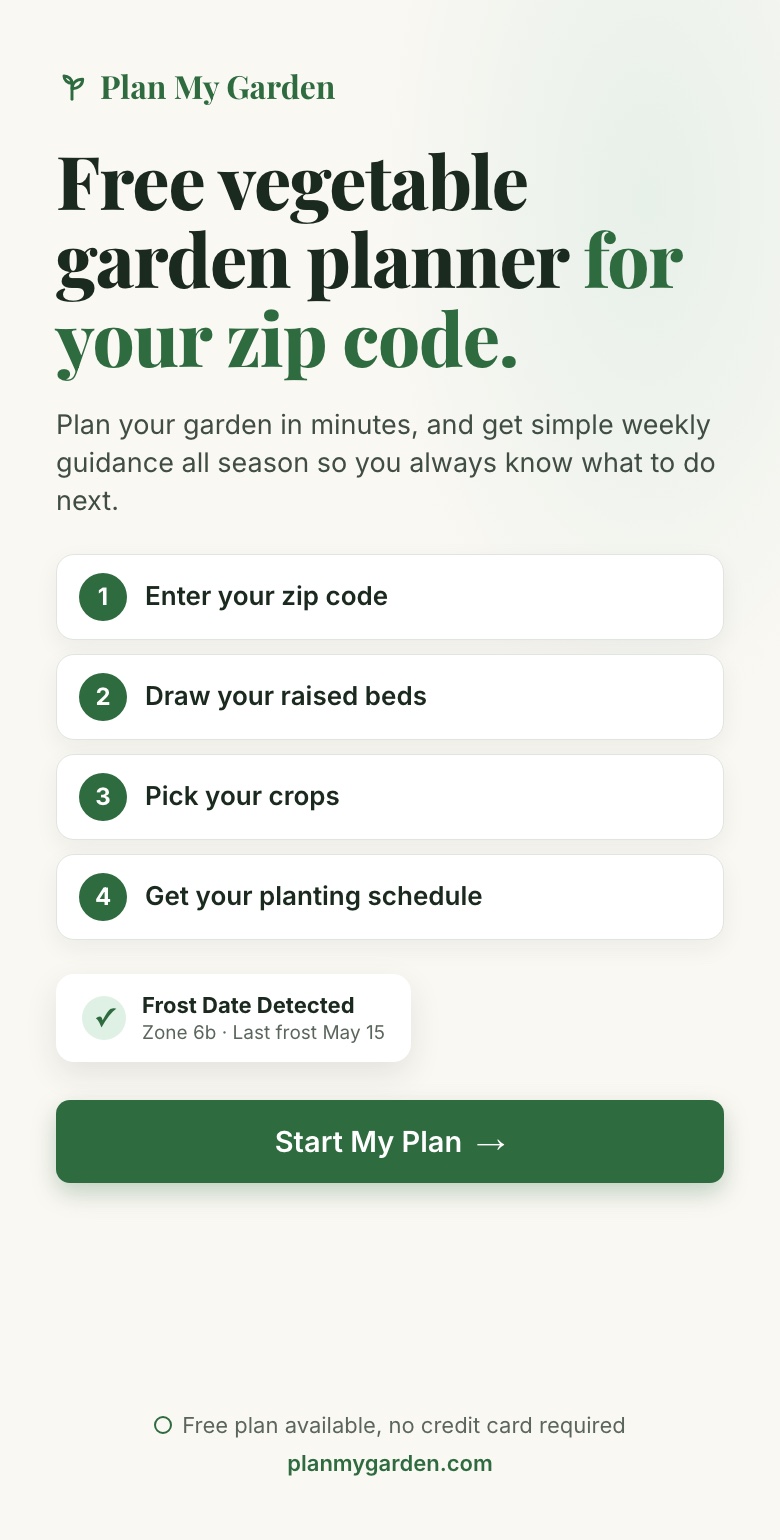
The planner turns your zip code’s frost dates into start-indoors and transplant dates. Plan My Garden is free to start: enter your zip code and it finds your frost dates, draw your beds, pick tomatoes and everything else you want to grow, and it places each plant at square-foot spacing and builds a planting schedule (start indoors, transplant and direct sow dates) from your frost dates.
Related: How to Prune Tomato Plants · The Florida Weave · How to Grow Peppers from Seed