Last Updated on October 9, 2026
How to Plant Garlic in Raised Beds (With Clove Counts for 4×4, 4×8 and 3×6)
Plant garlic in a raised bed in fall: 4 cloves per square foot, 6 inches apart, pointed end up and 2 to 3 inches deep, then water them in and mulch heavily with leaves or straw. At that spacing a 4×4 bed fits up to 64 cloves, a 4×8 up to 128 and a 3×6 up to 72, and each clove grows into a full head by the next summer.
How many cloves fit in 4×4, 4×8 and 3×6 beds
Each square foot gets a 2×2 grid of cloves. Set every clove 3 inches in from the edges of its square and every clove in the bed ends up 6 inches from its neighbors, across the square lines too. The most a bed fits is squares times cloves per square. A garlic head needs only its 6 inches, so a bed planted edge to edge at 4 per square is a realistic planting, not just a grid maximum.
| Bed | Squares | Fits at 4 per square (6 in apart) |
|---|---|---|
| 4×4 | 16 | 64 cloves |
| 4×8 | 32 | 128 cloves |
| 3×6 | 18 | 72 cloves |
4 per square is my spacing and the number on my square foot gardening chart, because a head needs about 6 inches to size up. University of Minnesota Extension also plants cloves six inches apart. Other extension guides allow tighter. Utah State University Extension spaces cloves 3 to 4 inches apart in the row, with rows 6 to 10 inches apart, and notes that high-density plantings reduce bulb size unless water and nutrients keep up. University of Maine Cooperative Extension spaces cloves 4 to 6 inches apart in rows 6 to 12 inches apart and says closer spacing gives smaller bulbs, wider spacing larger ones. Those tighter spacings are for rows, with more room between rows than between cloves, so they do not turn into a tighter square grid.
The single-square pattern is also on How Many Garlic per Square Foot.
How much seed garlic to buy
Seed garlic is sold by the pound, and the number of cloves in a pound depends on the variety. Wood Prairie prints a count on its seed garlic pages, so the pounds below are the cloves a bed fits at 4 per square divided by that count. Every figure is rounded up to the next 0.1 lb. For example, a 4×4 bed of Music: 64 ÷ 30 = 2.13, so 2.2 lb.
| Variety (type) | Cloves per pound | 4×4 (64 cloves) | 4×8 (128 cloves) | 3×6 (72 cloves) |
|---|---|---|---|---|
| Music, Georgian Fire (hardneck) | about 30 | 2.2 lb | 4.3 lb | 2.4 lb |
| German Extra-Hardy (hardneck) | 20 to 40 | 1.6 to 3.2 lb | 3.2 to 6.4 lb | 1.8 to 3.6 lb |
| Red Russian, Phillips (hardneck) | about 40 | 1.6 lb | 3.2 lb | 1.8 lb |
| Chesnok Red (hardneck) | 50 to 65 | 1.0 to 1.3 lb | 2.0 to 2.6 lb | 1.2 to 1.5 lb |
| Sicilian (softneck) | 80 to 90 | 0.8 lb | 1.5 to 1.6 lb | 0.8 to 0.9 lb |
You plant only the biggest cloves and eat the small ones, so buy a little more than the table shows.
Pick your garlic: hardneck or softneck
Hardneck garlic is the type for cold winters. It needs to be exposed to a freeze to make larger bulbs, and it sends up a flower stalk called a scape. Softneck garlic is better for milder climates, is the type you usually find in the grocery store, and keeps longer. University of Georgia Extension puts it the same way: hardnecks generally prefer cold winters and long, cool springs, while softnecks are well adapted to the more temperate climate of the South.
| Hardneck | Softneck | |
|---|---|---|
| Best for | Cold winters | Mild winters |
| Scapes | Yes | No |
| Cloves per bulb | 4 to 12 | 10 to 40 |
| Storage | 2 to 4 months | 6 to 8 months |
Cloves per bulb and storage life are general ranges from Rutgers Cooperative Extension fact sheet FS1233. Whichever type you choose, plant seed garlic, not grocery store garlic. Store garlic is often treated with growth inhibitors that can keep it from sprouting properly. Seed garlic costs more the first year, but after that you save your biggest bulbs and replant them.
Step 1: Get the bed ready
Garlic grows best in full sun but tolerates some shade. Loosen the soil and add organic compost so the bulbs have plenty to feed on. A raised bed already helps: Rutgers calls good drainage essential for garlic and names raised beds as one way to get it.
Garlic holds its squares from fall until harvest the next summer. Give it its own bed, or a block of squares you will not need for spring crops. In the 3×6 layout, the onion square can switch to garlic in fall.
Step 2: Split the bulbs and keep the biggest cloves
I break the bulbs apart the day I plant. University of Minnesota Extension separates cloves a day or two before planting, and University of Maine says shortly before planting. Rutgers peels off only the outer skin of the bulb and keeps each clove’s own papery wrapper and flat root end intact.
Sort as you go. The biggest cloves get planted and the small ones go to the kitchen. University of Maine Extension explains why: large cloves produce large bulbs, and smaller cloves produce smaller bulbs.
Step 3: Plant pointed end up, 2 to 3 inches deep
Push each clove into the soil fat end down, pointed end up, at the four points of the 2×2 grid in each square. A finger or a dibble makes the hole. Getting the point up matters; University of Maryland Extension says it is especially important for hardnecks.
How deep depends on how cold your winter gets. University of Georgia Extension notes that cloves can go slightly deeper in colder areas for winter protection.
| Winter | Depth | Source |
|---|---|---|
| Mild | 1 to 3 inches, slightly deeper in colder areas | University of Georgia |
| Cold, ground freezes | Base of the clove 2 to 3 inches below the surface | University of Minnesota |
| Very cold | 3 to 4 inches, a little deeper than in warmer climates | University of Alaska Fairbanks |
These are guides, not hard lines: Rutgers and University of Maryland both cover cloves with 1 to 2 inches of soil. My 2 to 3 inches is in line with the cold-winter row. Cover the cloves with soil and water them well.
Step 4: Mulch heavily
After planting and watering, mulch heavily. Mulch evens out winter temperatures, holds moisture, and keeps the bed weed-free until spring, when garlic is impossible to weed around. University of Minnesota Extension covers garlic beds with 3 to 4 inches of leaf or straw mulch; University of Maine uses three inches and notes that straw is relatively free of weeds, unlike most hay.
I like leaf mulch, which I pick up with my mower. I spray the leaves down so they do not blow away and lay a few dead branches over them. Straw blows around less, but it is not free like leaves. On a small bed, use shredded leaves, not whole ones, which mat into a wet sheet. The rest of my fall bed routine is in How to Prepare Your Garden for Winter.
Where winters are mild, University of Georgia Extension mulches after the garlic has come up instead: 2 to 3 inches over the bed, kept 2 to 3 inches back from the stems.
When to plant garlic
In fall, at or after your first fall frost, so the cloves can overwinter in the bed. University of Minnesota Extension plants one or two weeks after the first killing frost.
The cloves grow roots before winter, and the shoots usually wait until spring to come through the soil. Fall planting matters for bulb size: University of Maryland Extension says cloves need two months at 32-50°F before bulbs enlarge, which is why spring plantings produce smaller bulbs. The Plan My Garden planner counts about 240 days from planting to harvest.
To get your date, look up your first fall frost on Plan My Garden’s frost dates page.
Spring care: mulch, weeds and water
Mulch. University of Minnesota Extension removes mulch once the threat of hard freezes is over, so the soil warms up; you can also leave it for weed control and moisture. Rutgers removes it but leaves just enough to suppress weeds. University of Alaska Fairbanks adds that mulch left on keeps the soil from warming as quickly and slows growth.
Weeds. Garlic does not compete well with weeds, and University of Maine Extension says weed-free plantings produce larger bulbs. Pull weeds while they are small.
Water. Rutgers puts garlic’s need at about an inch of water a week during its spring growth, similar to other garden vegetables. Keep the soil moist but not waterlogged. One inch over one square foot is 144 cubic inches, or 0.623 gallons (a gallon is 231 cubic inches), so a week’s water is about 10 gallons for a 4×4 bed, 20 gallons for a 4×8 and 11 gallons for a 3×6.
Scapes, then harvest
Hardneck garlic sends up scapes before harvest; the hardneck I grow is Chesnok Red. I cut most of them so the energy goes into the bulb. University of Maine research found that leaving the scape on can cut bulb size by as much as 48 percent. I harvest a scape when it has made one full curl and is still tender: hold it near where it meets the stalk and pull gently upward, and it snaps off. University of Maine removes scapes earlier, before they curl, because its data show waiting until the curl costs about 9 percent of bulb size. Scapes have a mild garlic flavor and are good in hummus, in a stir fry and on the grill. I leave a couple to flower, because their bulbils grow into more garlic over two years. More in Garlic Scapes: What They Are and When to Harvest Them.
Once the scapes are off, I shut the water off on that bed and watch the bottom two leaves. When they turn brown, the bulbs are ready, usually a few weeks after the scapes. The extension guides agree on drying out first: Minnesota stops watering two weeks before harvest, Rutgers about a month before.
Loosen the soil with a small garden fork, lift the bulbs, and brush the soil off without washing them. Cure them in a shady, dry spot with good airflow for 2 to 3 weeks, then store them cool and dry, ideally at 56-58°F and 45 to 50 percent relative humidity. Save the biggest bulbs to plant next fall. The details are in Harvesting and Curing Garlic, and the whole season is in How to Grow Garlic.
Where to buy seed garlic
I recommend organic seed garlic from Wood Prairie Family Farm in Maine. Their hardnecks for cold climates include Chesnok Red, Music, German Extra-Hardy, Georgian Fire, Red Russian and Phillips. For hotter locations they list Sicilian, a softneck that keeps up to eight months. Seed garlic ships in time for fall planting and sells out early, so order soon. Code PMG5 takes 5 percent off, and buying through these links supports this site at no cost to you.
Quick questions
How deep do you plant garlic in a raised bed?
2 to 3 inches deep, pointed end up. Go a little deeper where winters are very cold (University of Alaska Fairbanks uses 3 to 4 inches) and a little shallower where they are mild (University of Georgia uses 1 to 3 inches).
How far apart do you plant garlic in a raised bed?
6 inches apart, which is 4 cloves per square foot, so a 4×4 bed fits up to 64 cloves, a 4×8 up to 128 and a 3×6 up to 72. Utah State University goes as close as 3 to 4 inches apart in rows 6 to 10 inches apart, but notes that dense plantings give smaller bulbs unless water and nutrients keep up.
Can I plant grocery store garlic in a raised bed?
Buy seed garlic instead. Store garlic is often treated with growth inhibitors that can keep it from sprouting properly, and most of it is softneck from a warm climate.
Should I take the mulch off garlic in spring?
Mostly. University of Minnesota Extension removes it once the threat of hard freezes is over so the soil warms up, and Rutgers leaves just enough to keep weeds down.
Does garlic need its own raised bed?
No. A block of squares in a mixed bed works, but garlic holds those squares from fall until harvest the next summer, so put it where you will not need the space for spring crops.
Let the planner place them
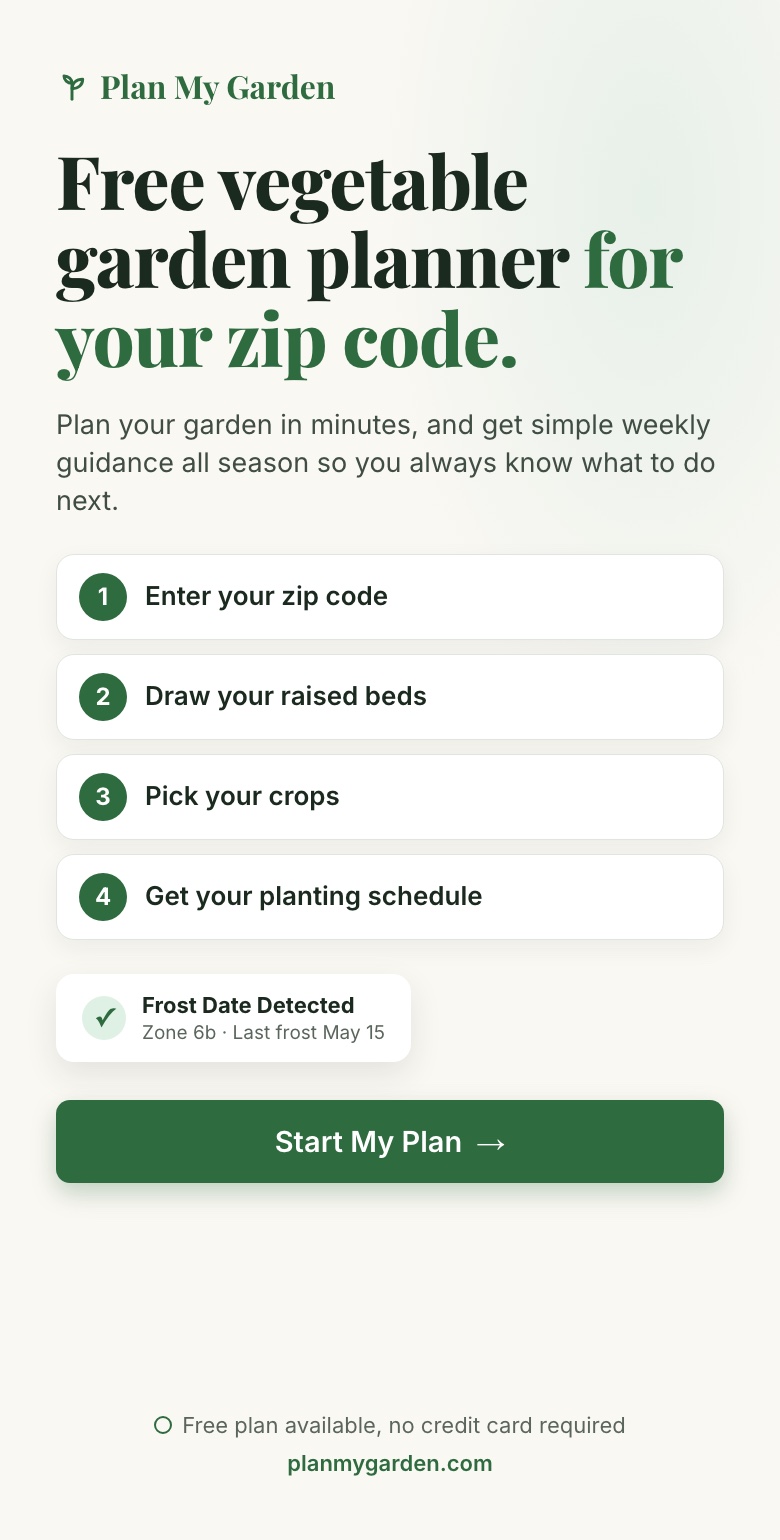
If garlic shares a bed with spring crops, map the squares before the cloves go in. Plan My Garden is free to start: enter your zip code and it finds your frost dates, draw your beds, pick garlic and everything else you want to grow, and it places each plant at square-foot spacing and builds a planting schedule from your frost dates.
Related guides: How many garlic per square foot · How to grow garlic · Harvesting and curing garlic · 4×4 raised bed layout · 4×8 raised bed layout · Square foot gardening chart · Charts and Tools hub