Last Updated on September 18, 2026
Maple Syrup Finishing Temperature (and Your Altitude)
Maple syrup is finished when it boils at about 7.1°F above the boiling point of plain water at your location that day, not at a fixed number like 219°F. Water’s boiling point moves with altitude and the day’s weather, so the true finishing temperature moves with it. Ohio State University Extension and University of Maine Cooperative Extension both give 7.1°F above boiling water as the point where syrup reaches 66° Brix, the low end of the standard density range. University of New Hampshire Extension gives the closely related Vermont and New Hampshire standard of 67° Brix, which boils 7.5°F above water, about 219°F at sea level. Boil a small pot of plain water in the same room as your evaporator on the day you finish syrup and use that reading, not 212°F, as your baseline.
Finishing temperature calculator
Enter your altitude, or the boiling point of plain water you measured today, and get the temperature to pull your syrup.
219.1°F
Target finishing temperature at sea level (212.0°F boiling point), 7.1°F above boiling.
This is a starting point. Always confirm with a hydrometer or refractometer.
Boiling point and finishing temperature by altitude
The boiling point of water falls by about 1.8°F for every 1,000 feet of altitude. This table (7.1°F standard) is calibrated from a boiling point and altitude reference table hosted by the University of California, Davis Food Safety program, and matches the calculator above.
| Altitude | Water boils at | Syrup finishes at (+7.1°F) |
|---|---|---|
| Sea level | 212.0°F | 219.1°F |
| 1,000 ft | 210.2°F | 217.3°F |
| 2,000 ft | 208.4°F | 215.5°F |
| 3,000 ft | 206.6°F | 213.7°F |
| 4,000 ft | 204.8°F | 211.9°F |
| 5,000 ft | 203.0°F | 210.1°F |
| 6,000 ft | 201.1°F | 208.2°F |
| 7,000 ft | 199.3°F | 206.4°F |
| 8,000 ft | 197.4°F | 204.5°F |
Treat this table as a starting point only. Ohio State University Extension is direct about why: the boiling point also shifts with the day’s barometric pressure, sometimes by a couple of degrees on its own, so the only reliable number is the one you measure yourself, the same day, in the same room as your evaporator.
Where 7.1°F and 219°F come from
Maple syrup is density, not a temperature. Standard finished syrup falls between 66° and 68° Brix (a measure of sugar concentration), with Vermont and New Hampshire’s own standard set at 67° Brix at 60°F, according to University of New Hampshire Extension. A denser liquid boils hotter than plain water, and 66° Brix syrup happens to boil right at 7.1°F above the boiling point of water, per Ohio State University Extension and the University of Maine Cooperative Extension’s 2025 tapping and syrup bulletin. The Vermont and New Hampshire 67° Brix standard boils a little hotter still, 7.5°F above water, which UNH Extension notes comes out to about 219°F if you are boiling at sea level under average barometric pressure. Below 66° Brix, syrup can ferment or grow mold in storage; above 68° to 69° Brix, sugar crystals can form in the jar.
None of that changes what you actually do at the stove: check the boiling point of plain water that day, then add 7.1°F (or 7.5°F if you’re working to the denser VT/NH standard) to find your own target.
Why a hydrometer or refractometer beats a thermometer
A thermometer only tells you the boiling point is correct if you calibrated it against today’s boiling water, in the same room, right before you finished the batch. University of Maine Cooperative Extension recommends a syrup hydrometer and test cup as the more reliable call for a bigger batch, and Ohio State University Extension’s guide to syrup density walks through the process: warm the hydrometer cup with hot syrup first so it doesn’t cool the sample, fill it fully to clear the foam, then read the Brix scale at the flat part of the liquid surface, not the curved edge where it meets the glass. A refractometer works from a drop of cooled syrup and gives a Brix reading directly, which is why many hobby sugarmakers keep one next to the evaporator alongside a thermometer.
This page is about the temperature side of finishing syrup only. It does not replace the Maple Sap to Syrup Calculator, which answers a different question: how many gallons of sap, at your sap’s Brix, it takes to get a gallon of finished syrup. Use that calculator to plan how much sap to collect, and this page’s calculator to know when to pull the pan off the heat.
Quick questions
What temperature does maple syrup finish at?
About 7.1°F above the boiling point of plain water at your location that day, roughly 219°F at sea level under average conditions. The exact number moves with your altitude and the day’s barometric pressure, so it is not a fixed temperature everywhere.
Why isn’t 219°F the same everywhere?
Because water itself does not boil at the same temperature everywhere. The boiling point of water falls by about 1.8°F for every 1,000 feet of altitude, and it also shifts a little with the day’s weather, so 219°F only applies near sea level under average barometric pressure.
How much does altitude change the finishing temperature?
About 1.8°F lower for every 1,000 feet of elevation. At 2,000 feet, water boils around 208.4°F, so syrup finishes around 215.5°F, roughly 3.6°F cooler than the sea level target.
Do I need a hydrometer if I already use a thermometer?
It helps, especially for a full batch. A thermometer only works if it is calibrated in that day’s boiling water first. University of Maine Cooperative Extension recommends a hydrometer and test cup for a more reliable density check, and a refractometer is a fast alternative that reads Brix from a single drop.
Does this calculator replace the sap to syrup ratio calculator?
No. This page only covers the finishing temperature. Use the Maple Sap to Syrup Calculator to figure out how many gallons of sap, at your sap’s Brix, it takes to make a gallon of syrup.
Let the planner handle the rest of the season
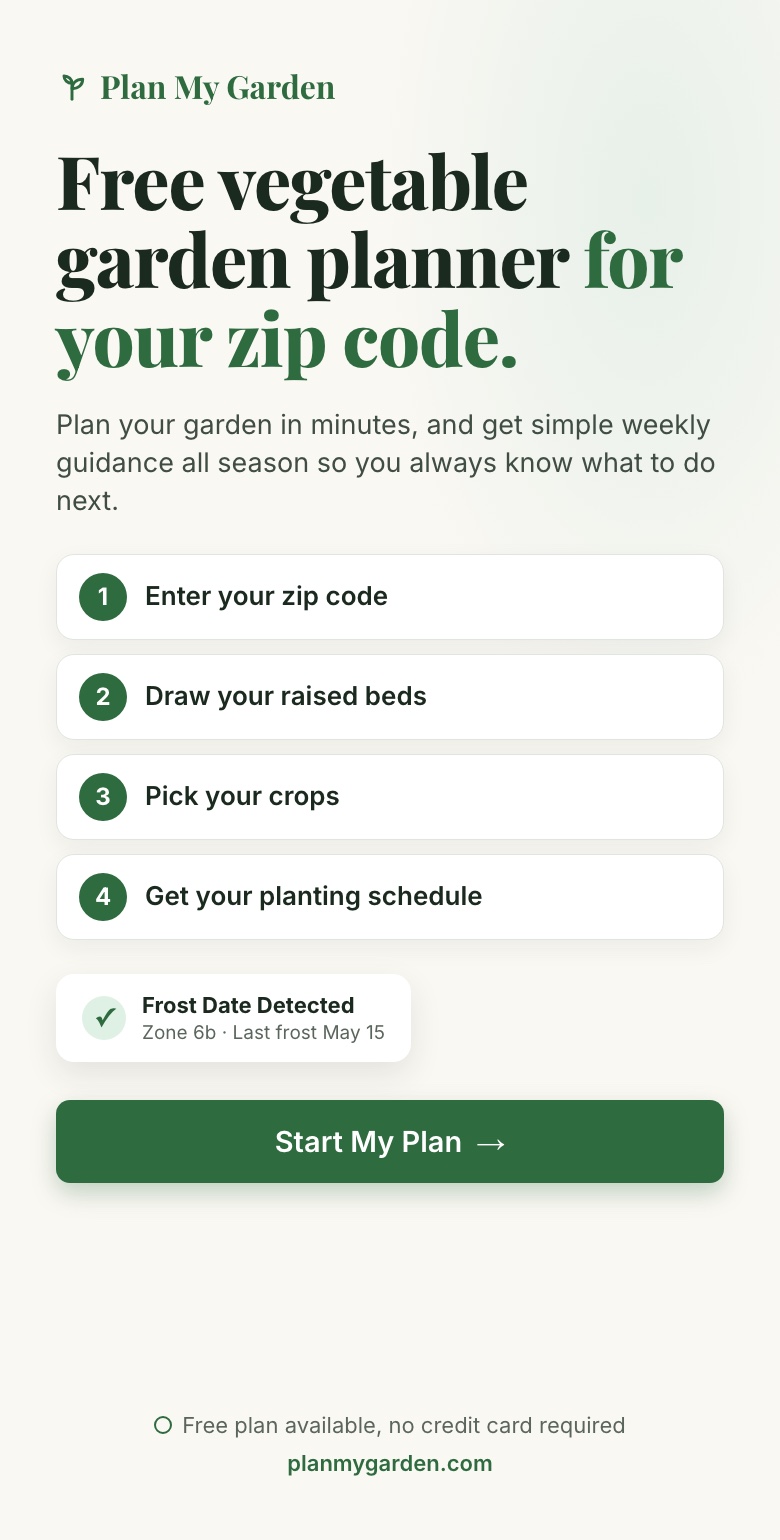
Plan My Garden is free to start: enter your zip code and it finds your frost dates, draw your beds, pick everything you’re growing this year, and it places each plant at square-foot spacing and builds a planting schedule from your frost dates, so your beds are ready as soon as sugaring season winds down.
Related: Maple Sap to Syrup Calculator · How Many Taps per Maple Tree? · How to Build a Cheap Maple Syrup Evaporator · Charts and Tools